
There’s a moment in every adult child’s life usually somewhere between the second unanswered call and the third manually-entered calendar reminder when you realise you’ve become infrastructure.
Not a daughter. Not a son. Infrastructure. The invisible coordination layer between your parents and the healthcare system that was supposed to serve them.
I’ve been thinking about why that happens. And the more I map it, the more it looks less like a technology gap and more like a design gap specifically, a failure to design for the right user in the first place.
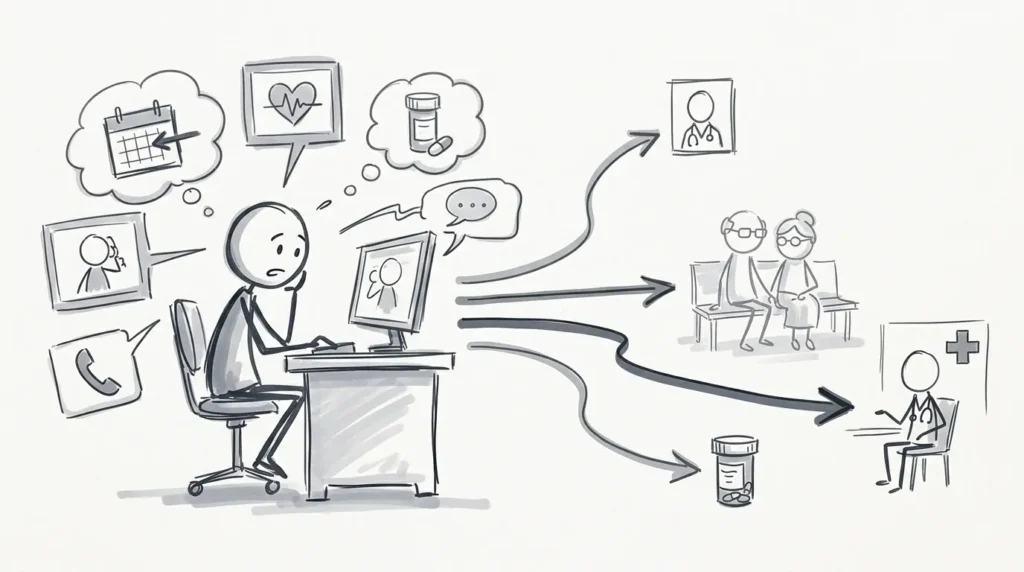
The System Has a Stakeholder It Hasn’t Named
Senior health tech typically centres on one user: the elderly person. Wearables, medication reminders, telemedicine apps: all designed with the senior citizen as the primary actor. That framing isn’t wrong. But it’s incomplete in a way that has real consequences.
In service design terms, every care journey has a set of stakeholders. For senior health in India, the map usually includes the patient, the doctor and the caregiver in the home. What it consistently leaves off is the adult child who has moved cities, the person managing the coordination layer remotely, across time zones, between meetings with no tools built for them.
That’s not a minor omission. That person is doing the work the system hasn’t automated: scheduling checkups, tracking medication cycles, following up on referrals and maintaining the health record that no single provider holds in full.
They are performing care coordination without a title, a tool or acknowledgement that they exist as a user at all.
Mapping What’s Actually Breaking
I went in thinking this was a devices problem. The more I mapped it, the more I realised it wasn’t.
When I traced my own experience managing my parents’ health from a distance: the calls, the calendar reminders, the medication refill cycles tracked in a notes app.
Three gaps surfaced consistently. Not technology gaps. Coordination gaps.
The Information Gap. No single view of my parents’ health exists anywhere. Their blood pressure readings are with one doctor. Their eye history is with another. The medication list lives in my mother’s memory and my own notes app. There is no shared source of truth which means every health interaction starts from scratch and the person doing the reconstructing is me.
The Handoff Gap. The moments that matter most: a test result, a specialist referral, a prescription change have no formal handoff mechanism to the family member managing remotely. I find out when someone remembers to call. The system has no way of knowing I’m a stakeholder, let alone notifying me.
The Anticipation Gap. Preventive care: the annual eye check, the dental visit, the quarterly follow-up is entirely self-managed. There is no nudge layer. No one is watching the calendar except me.
The reframe that followed was the same one that shaped the LifeLane project: the problem isn’t the individual component that’s missing. It’s that nobody has designed the shared picture, the coordination layer that connects every component into something that functions as a system.
What Actually Exists And Where It Stops Short
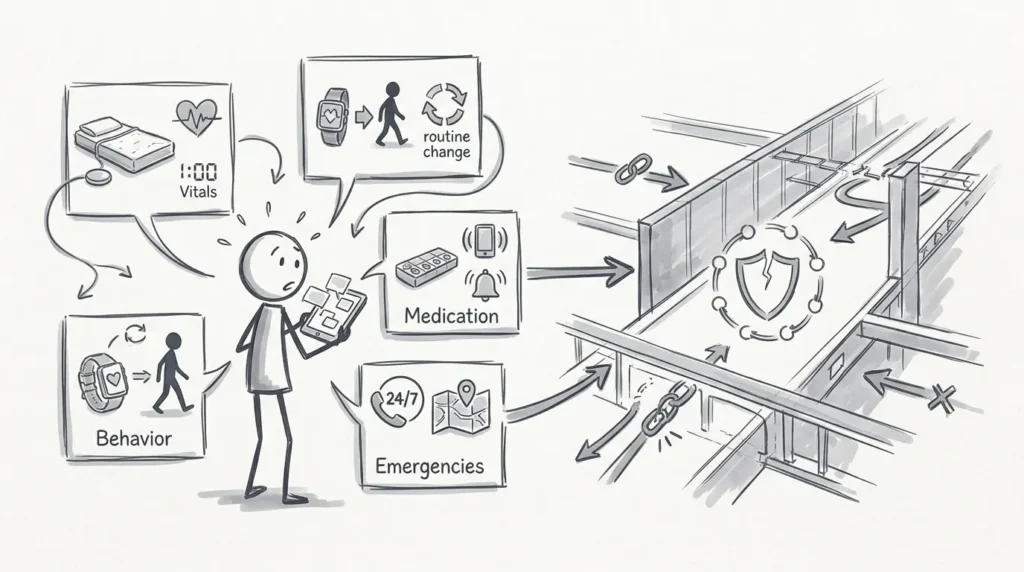
Here’s the part that genuinely frustrates me as a designer: the technology exists. Some of it is built right here in Bengaluru.
Dozee, a Bengaluru startup makes a contactless sensor that slides under a mattress and silently tracks heart rate, respiration, sleep patterns and blood pressure : no wearable, no buttons, nothing for an elderly parent to learn or remember. Their AI flags deviations and sends real-time alerts to a family app. They even launched a service called Shravan specifically for families monitoring parents remotely originally aimed at NRIs abroad but the same distance problem applies to anyone working in a different city within India.
Globally, products like CarePredict’s Tempo go further, a wrist device paired with room sensors that tracks behavioural patterns: eating less, sleeping more, moving differently. It doesn’t just monitor vitals, it notices when routines change, which is often the earliest signal of a health decline.
On the medication side, smart pill dispensers now exist that alert a family member if a dose is missed. Not a text from my mother saying she forgot. An actual automated alert triggered by the box itself.
And then there’s Emoha, an Indian eldercare platform with a 24/7 emergency helpline, daily check-in calls and hospital partnerships now expanding to Tier 2 and 3 cities. So the devices exist. What’s missing is the layer above them.
Dozee closes the Information Gap for vitals. Emoha provides a human handoff layer for emergencies. But none of these solutions talk to each other. None of them connect to the diagnostic lab, the neighbourhood clinic or the specialist’s calendar. And none of them were designed with the adult child in Bengaluru as a first-class user (not the NRI in California) but the internal migrant living three hours away.
The result is a market full of point solutions to a systems problem. India’s home health monitoring sector is projected to grow from $768 million to over $3 billion by 2033. That number tells you the demand signal is enormous. It doesn’t tell you the coordination layer has been built.
The Bengaluru Paradox
Bengaluru is a particularly strange place to sit with this problem.
This was once genuinely a pensioner’s city: good weather, a slower pace, affordable and comfortable living. My parents’ generation built their retirement plans around it. Then the IT boom happened and Bengaluru became something else entirely. World-class hospitals, cutting-edge diagnostic infrastructure and an engineering ecosystem that has built coordination layers for fintech, for logistics and for food delivery. We solved restaurant-to-customer coordination. We solved cab dispatch. We solved same-day grocery delivery to apartments.
The family managing an ageing parent’s care across city lines is a harder coordination problem than any of those and nobody has seriously attempted it.
What the Brief Actually Is
If I were writing this as a design brief, it would read something like this:
Design a family-facing care coordination layer for urban Indian adults managing one or more ageing parents in a different city. The system must:
- Give the adult child a single, reliable view of their parent’s health not a firehose of vitals but meaningful signals. Did she sleep well? Has he been moving around today? Is the prescription about to run out?
- Close the handoff gaps: test results, prescription changes, specialist referrals so the coordination doesn’t depend on someone remembering to make a phone call.
- Build the anticipation layer: preventive care reminders, checkup schedules, medication cycles calibrated to the family’s actual rhythms not generic push notifications.
- Integrate with the infrastructure that already exists: the diagnostic labs, the neighbourhood clinics, the pharmacy chains. Don’t rebuild the healthcare system. Coordinate it.
- Work in the connectivity and literacy conditions of suburban and rural India. Design for the parent in Mysuru, not a resident of Koramangala.
- Hold the senior citizen’s dignity throughout. This is a care companion not a monitoring device.
None of this is speculative technology. Every component exists. What hasn’t been built is the layer that connects them and treats the worried adult child as a primary user, not an edge case.
Where I Would Start
I’ve been circling this problem for longer than this post suggests.
Early in my career, I worked on a collaboration with GE Healthcare through NID: my first exposure to clinical UX and the first time I understood that designing for healthcare wasn’t about making interfaces cleaner. It was about designing for the moments when the stakes were too high for confusion. That instinct has stayed with me.
More recently, the Nudget project a behavioural study of how urban Indians actually manage money not how they say they do taught me that the gap between intended behaviour and actual behaviour is almost always a design failure not a user failure. People aren’t bad at tracking expenses. The systems asking them to do it were badly designed for their actual lives.
Senior health management has the same structure: people aren’t bad at caring for their parents. The system has simply never been designed around how that care actually happens.
If I were approaching this as a research and design problem which I am because I can’t help it. I’d start not with the devices but with the invisible coordinator. I’d want to spend time with the adult children who are currently being the system: mapping their actual workflows, their workaround tools, the moments of highest anxiety and lowest information. The Dozee sensor is only useful if it surfaces the right signal at the right moment to the right person. Getting that right is a research problem before it’s an engineering problem.
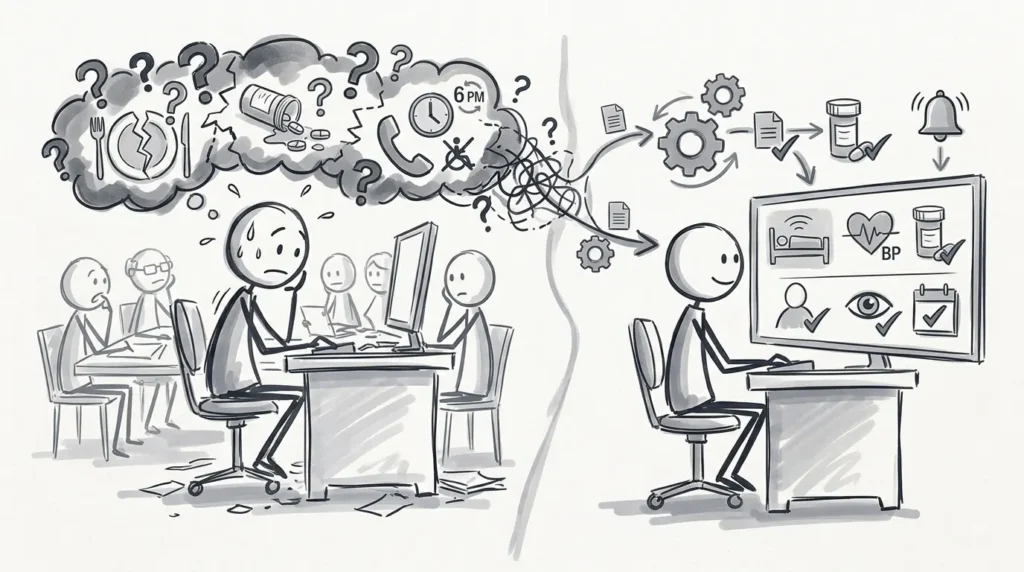
And what that research is ultimately in service of is this:
Picture a Tuesday afternoon. You’re in back-to-back meetings, the kind where you can’t check your phone. Somewhere in the back of your mind as it always is, is the quiet question: has she eaten? Did he take his medication this morning? You don’t know and you won’t know until you call and you can’t call until 6pm and by then you’ve spent four hours carrying that question through every room you walked into.
Now picture the same Tuesday where you don’t carry that question. Not because you’ve stopped caring but because a system that was actually designed for you is watching the things that matter and it will tell you if something changes. The ophthalmologist reminder went out last week. The prescription refill happened automatically. The only reason you’d hear from the system today is if something is genuinely wrong.
That’s the shift. From anxiety as a chronic background condition to confidence as a designed outcome. From invisible coordinator to informed family member. One is a workaround. The other is what good looks like.
A note on perspective: I’m a UX researcher and designer. I think in systems, coordination failures and unmet user needs. This post comes from that lens and from personal experience managing my parents’ care from a distance. I’m not a medical professional or an eldercare specialist. If you’re evaluating specific products or care plans, please do your own research and consult the right people.