Role : Independent User Researcher & Parent
Duration : 10 Years · Birth through mid-primary school (includes COVID-19 period)
Expertise : Longitudinal Observation · Developmental Research · Behavioural Frameworks
Project Type : Personal Pedagogical Case Study
Location : Home environment, urban Bengaluru, India
Abridged Version
Copyrighted material. Not for redistribution. Please reach out directly for permissions or citation details.
This case study began with a missed phone call.
She was somewhere between bath and bed. For a neurodivergent child, those few minutes can be anything but ordinary. The crying had started with the change in activity. Not defiance. Dysregulation. Her nervous system was registering the shift as threat.
I had a phone in my hand. I reached for a book instead.
I don’t know, honestly whether that was principled or just habit by then. We had already decided months earlier, before she could hold a book on her own that books and vinyl would come first. Not instead of screens. Before them.
The reasoning felt intuitive at the time. The research which I would spend years reading more carefully, confirmed it.
It led me to explore a simple question: what should support look like for a neurodivergent child before technology enters the picture?
The question that reframed the whole project
I went in believing this was a problem of protection. Keep the screens away, buy time and hope for the best.
It wasn’t.
The more I read about how attention, regulation and executive function actually develop, the clearer it became: the risk wasn’t screens. It was sequencing. A developing nervous system shaped by dopaminergic media before it has a chance to build its own regulatory architecture. The absence of a screen isn’t protection. It’s only a pause. What matters is what you put in that pause.
The question shifted from how do we limit screen exposure to:
How do we build the cognitive and regulatory infrastructure she’ll need to engage media as something she controls rather than something that controls her?
That single reframe is what the next ten years were actually about.
Meeting the one person who’d use this
A note on how I got here: there is one subject. My daughter. Female, Generation Alpha, neurodivergent with sensory processing sensitivities that shaped almost every design decision in what follows. This is a longitudinal observation study of one child in a specific home environment with specific parental resources of time, access, knowledge that are not universally available. I’ll say more about that limit later.
She didn’t give me quotes. But she gave me signals I learned to read.
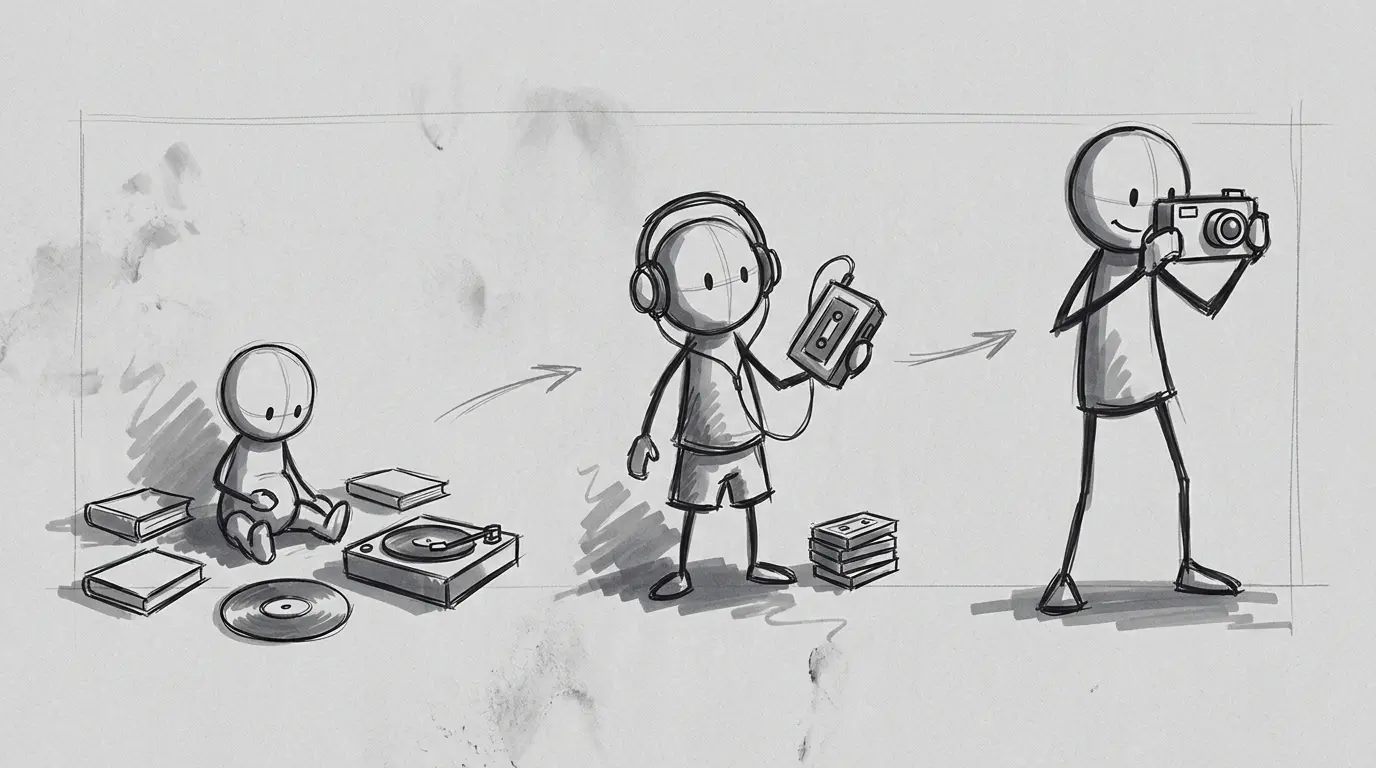
At two months, she responded to vinyl’s acoustic warmth differently than to digital streaming. By two years, visually dense books held her regulated attention longer than simpler ones. At four, she stood watching the cassette player for weeks before she wanted to touch it. By seven, she was photographing landscapes, people and food classifying her visual world into stable categories without being asked.
Each of those signals told me something about what she was ready for next.
The challenge wasn’t media. It was sequence.
Generation Alpha is the first cohort born entirely into the smartphone era. The media they inherit isn’t neutral infrastructure. It’s an attention economy optimised for engagement at the expense of regulation: algorithmic feeds, autoplay, notification loops, gamified reward structures and architectures designed to exploit the executive function gaps that a neurodivergent child is still building.
Three gaps kept the problem in place:
The readiness gap : Screen environments assume regulatory capacity that many children, especially neurodivergent ones, haven’t developed yet. They’re not designed to meet the child where they are.
The sequencing gap : Most approaches to child media are either permissive or restrictive. Neither is a developmental strategy. The question of order what comes before what, and why rarely gets asked.
The infrastructure gap : A child who encounters sophisticated media architectures without first building inhibitory control, sustained attention and the schema that media is something I operate is handed a system they can’t yet manage. And once the regulatory architecture is shaped by dopaminergic media, rebuilding it is much harder than building it right the first time.
What the approach was designed to do
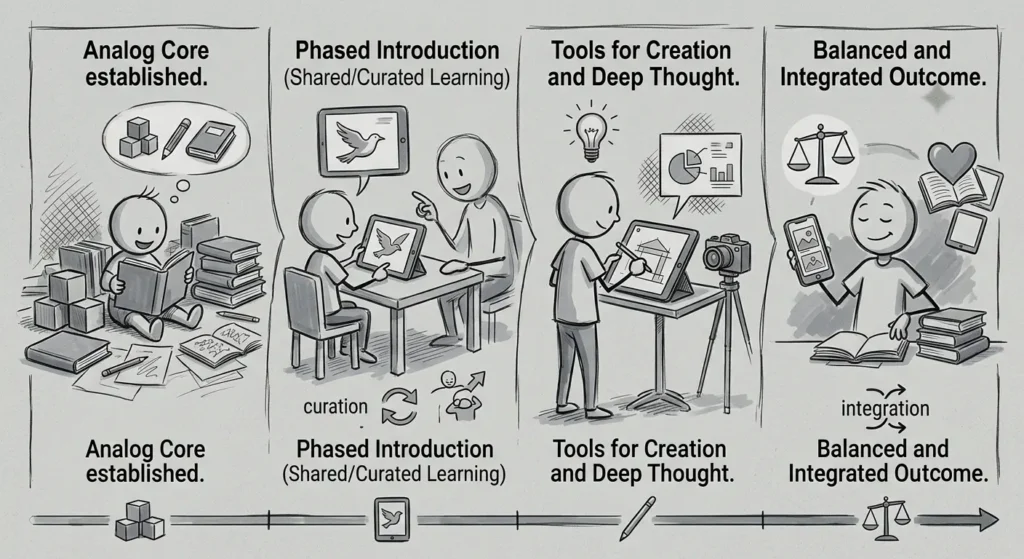
The working principle was simple to state and required ten years of discipline to hold: introduce each layer of media only when the prior layer’s mental model was consolidated. Analog first and not because screens are harmful but because analog media has properties that digital media lacks. Physical cause-and-effect. Defined endpoints. Non-escalating stimulation. No algorithm.
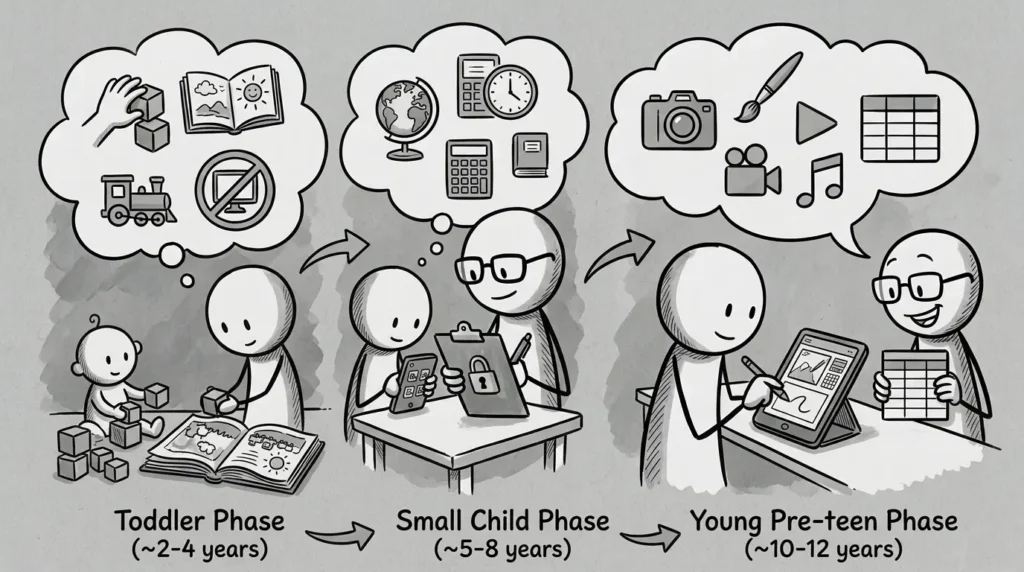
| Phase | Age | What Was Introduced | Why, Then |
| I | 0–2 | Books, vinyl records | Tactile objects and co-regulatory voice. The cognitive content is secondary. what matters is the regulated nervous system she’s borrowing from mine while hers is still forming. |
| II | 2–4 | Expanded library (dense, complex visuals) | Visually rich books held attention longer. Books became the primary transition tool placed at the high-dysregulation moments, they gave her nervous system somewhere to land. |
| III | 4–5 | Cassette and CD players | She watched the mechanics for weeks before she touched them. When she finally operated the CD player alone, the mastery was hers and not taught, earned. Physical cause-and-effect visible enough to build a real mental model. |
| IV | 5–6 | Desktop (COVID classes) + iPad / Khan Academy | Necessity-driven. What we controlled was how: task-bounded, parent-mediated, defined start and end. No ambient screen time. We stayed in the room. |
| V | 6–7 | iPod Shuffle (no screen, no algorithm, no social features) | Her first personally owned device. She could now access regulatory support that is music, her own curation without needing us to provide it. The transition from co-regulation to self-regulation had begun. |
| VI | 7+ | iPod with Cover Flow + digital camera | Cover Flow is closer to flipping through a record collection than scrolling a feed. The camera introduced something more important: authorship. She became a maker of images, not a consumer. |
Designing for a nervous system that can’t just be told
The hardest constraint wasn’t resources or time. It was that none of this could be explained to her. The sequence had to make sense through experience and not explanation. The design had to work through structure and not instruction.
Boundaries had to be physical before they were internalized.
Books at transition moments wasn’t an accident, it was a recurring design choice. Place the regulated object at the threshold and the nervous system has somewhere to land. We used this across years, at every high-dysregulation edge of the day.
Watching before touching was the curriculum.
With the cassette and CD players, the rule was simple: she could watch as long as she wanted before she touched. Not withholding but preparation. When she operated the CD player independently, she already had a complete mental model of how it worked. The Montessori principle in practice: children derive satisfaction from watching competent adults use real tools before attempting them.
The iPod Shuffle’s simplicity was only legible because of everything that came before.
No screen, no album art, no algorithm. Navigable precisely because the schema of device, action, music had been built on objects with far more visible mechanics over six years. Abstraction works when concrete understanding is already solid.
The camera was the most important design decision of Phase VI.
Choosing what to photograph requires making explicit decisions about what is worth remembering. That is a metacognitive act as it asks us to reflect on our own attention, priorities and intentions. Passive image consumption rarely demands the same kind of reflection. She is now the author of her own visual world and that orientation is probably the most durable outcome of the entire decade.
Where this could break
Because this case study spans years of real life and not a controlled study, I can’t paper over the moments that were harder than the narrative makes them appear.
The COVID screen boundary.
When lockdown forced screen introduction into Phase IV, the regulatory architecture held but only because the sessions had structure: task-based, parent-mediated and defined endpoints. Transitions out of screen sessions were harder than any pre-COVID transition had been. We had not built internalised endpoints before the screen arrived. External boundaries had to precede internal ones and that took months to stabilise. The insight: it wasn’t the medium that caused dysregulation, it was the absence of a legible endpoint she had made her own.
The social cost.
By the age of six, most of her peers had unrestricted access to screens. The difference was impossible to miss at play dates where conversations often turned to YouTubers, games or shows she had never seen. She realised, sometimes painfully, that our family did things differently. We didn’t change course but that decision came with a genuine social cost for her. It would be dishonest to pretend otherwise.
Temperament vs. intervention.
I cannot fully disentangle the approach from the child. Her neurological profile is specific. Another neurodivergent child with different sensory sensitivities and different attachment history might respond very differently to the same sequence. What I can claim is that the approach was coherent, principled and produced observable results in this child. I cannot claim more.
What this project actually is
I want to be upfront about what this case study is and isn’t.
This is a longitudinal observation of a single child in a specific home environment by a researcher who is also the parent. It is not a clinical study. It is not generalisable. The N is 1.
That was a deliberate choice to document, not a gap I’m hoping you won’t notice. I was more interested in the question of what does a developing nervous system need, in what order, before it meets the architectures designed to exploit its gaps? than in producing results I can’t honestly claim. The outcome here is the reasoning: where the developmental risks actually sit, what each phase was designed to build, and a sequence that held across ten years with one child.
So there’s no cohort comparison or clinical metric to report. I’d rather say that plainly than dress up a hypothesis as a result. What I can show is what was observed, and the theoretical lenses that make it interpretable.
What was observed (not concluded)
| Area | What Was Observed |
| Nervous system regulation | Independently accesses music and books as regulatory supports without prompting. No dysregulation upon media removal as the architecture is internalized and not enforced. |
| Sustained attention | Progressive tolerance for voluntary, seated attention built across the book-expansion years. Evident now in autonomous music library management and deliberate photographic practice. |
| Media as something she operates | Understands media as constructed and controllable. Physical media mastery created a generative mental model she applies to every new device and she approaches them as objects to figure out, not environments to inhabit. |
| Authorship orientation | Photography practice seeded an early authorial relationship with visual media. She makes images. That orientation is maker, not consumer and is perhaps the most important single outcome of the decade. |
What I still don’t know
How durable is this architecture when she encounters at scale and without mediation, the social media environments her older peers already inhabit? The executive function built here was developed against relatively mild pulls. The systems she’ll meet in adolescence are substantially more sophisticated.
What does the camera practice become?
These aren’t rhetorical closures. The decade isn’t finished. I’ll keep watching.
What I took away from this
The most important work here wasn’t any single phase. It was the sequencing and holding to a developmental order at moments when the easier thing was to hand over the phone.
If there’s one thing this project left me with, it’s this: a child prepared for media is not the same as a child protected from it. Restriction is a pause. Preparation is infrastructure. The analog-first approach was never about fear. It was about building the architecture first and then introducing the environments it would need to manage.
She was never going to avoid screens. She just arrived at them ready.