
Designing a Coordinated Emergency Response Service for Urban India
Role : Lead Product Designer & Service Designer
Duration : 4 Weeks
Expertise : Service Design • Systems Thinking • Service Blueprinting • Stakeholder Mapping • Interaction Design • Information Architecture
Project Type : Speculative Service Design Concept
Location : Bengaluru, India
Overview
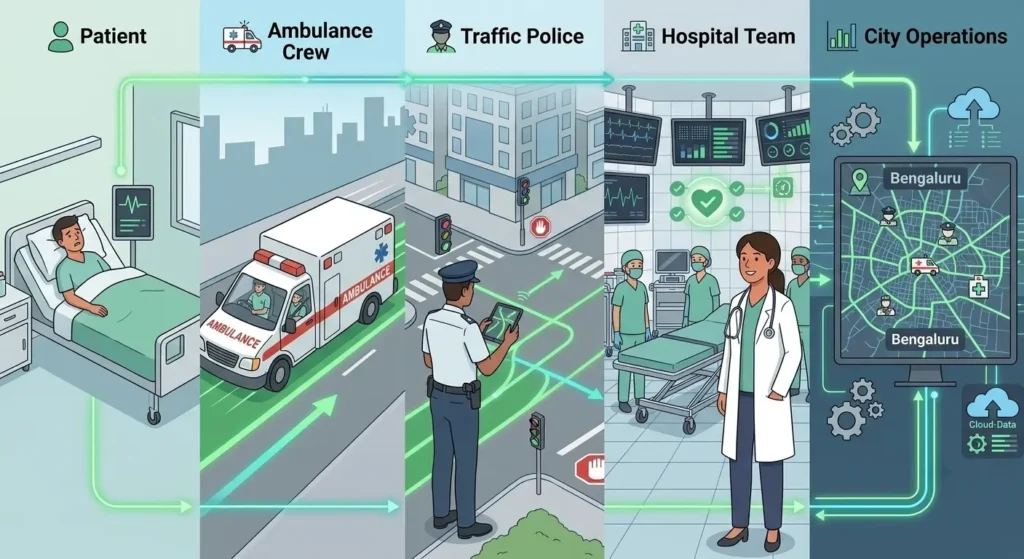
In emergency medicine, the first 60 minutes after a critical incident commonly known as the Golden Hour can determine survival outcomes.
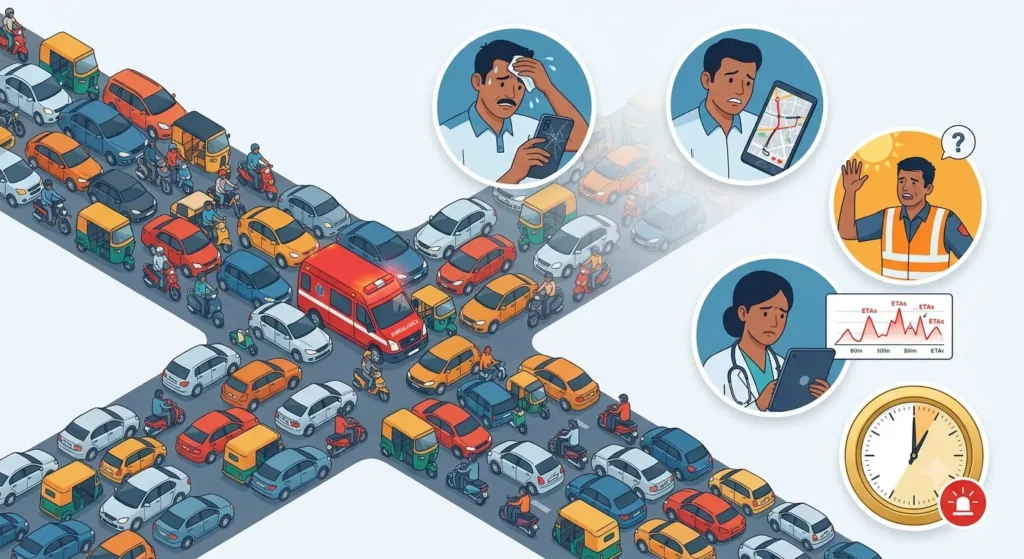
In Bengaluru, severe traffic congestion creates uncertainty throughout the emergency response journey. Ambulances face unpredictable travel times, traffic officers receive little advance notice, and hospitals struggle to prepare for incoming critical patients due to unreliable arrival estimates.
LifeLane explores how a coordinated emergency response service could connect hospitals, ambulance operators, and traffic management stakeholders to improve continuity of care during the critical Golden Hour.
The Challenge
Understanding the Current Experience
Through secondary research and stakeholder analysis, I mapped the emergency response journey from patient pickup to hospital arrival.
The investigation revealed that delays were not caused by a single point of failure.
Instead, the entire ecosystem operated with fragmented information.
Ambulance Teams
Drivers often made routing decisions without knowing which roads could realistically be cleared in time.
Traffic Police
Traffic officers became aware of approaching ambulances only when sirens were audible, leaving limited time to create a clear path.
Emergency Departments
Hospital staff relied on fluctuating GPS estimates, making treatment preparation difficult.
Problem Statement
How might we help emergency response stakeholders share reliable, real-time situational awareness so critical patients can reach treatment faster during the Golden Hour?
Current State Journey & Discovery :
Stakeholder Ecosystem
The emergency response journey involves multiple interconnected actors.
Primary Stakeholders
- Patients
- Ambulance Drivers
- Emergency Medical Technicians
- Traffic Police Officers
- Emergency Room Coordinators
- Emergency Physicians
Supporting Stakeholders
- Hospital Administrators
- City Traffic Management Authorities
- Infrastructure Partners
- Insurance Providers
Service Gaps
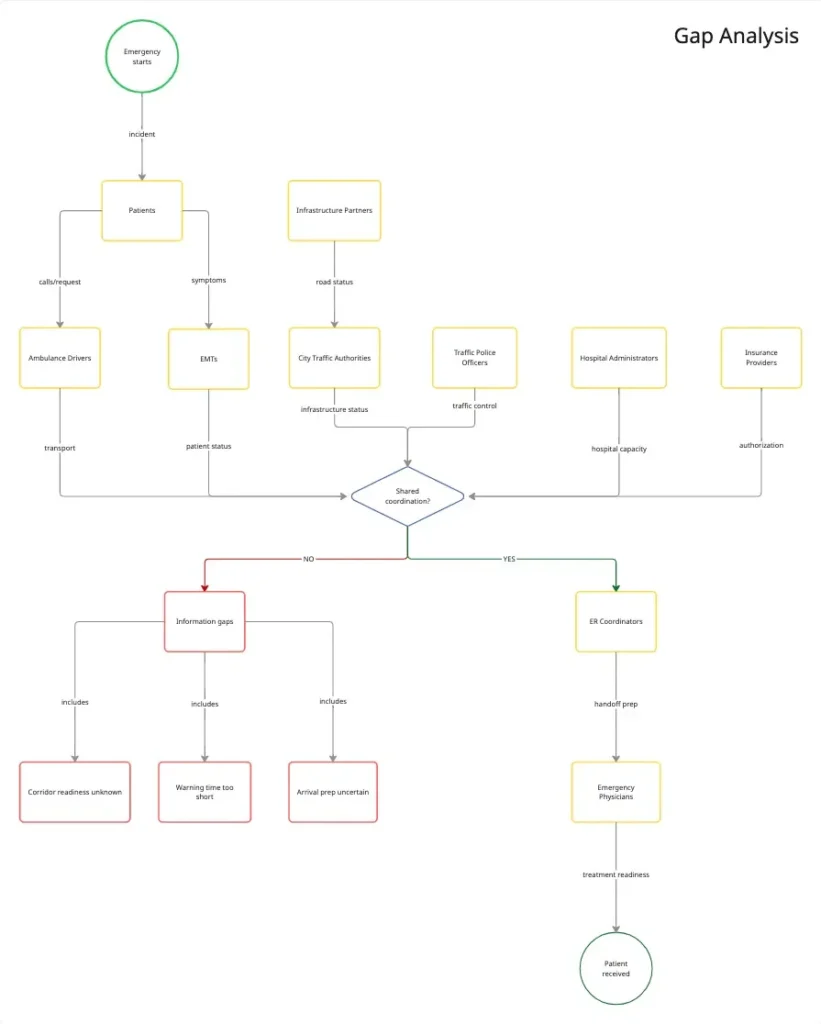
Information Gap
No shared operational awareness between stakeholders.
Timing Gap
Traffic intervention occurs too late.
Reliability Gap
Arrival estimates cannot be trusted.
Key Research Insight
The challenge was not navigation.
The challenge was coordination.
Each stakeholder operated with different information, different priorities, and different visibility into the patient journey.
As a result:
- Ambulances could not predict corridor readiness.
- Traffic officers lacked sufficient warning time.
- Hospitals could not confidently prepare for arrival.
Service Opportunity Areas
Research revealed a critical service gap:
No stakeholder had a shared source of truth regarding ambulance movement.
This led to the core opportunity:
Create a city-wide coordination layer between ambulances, traffic officers, and hospitals.
Three service opportunities emerged:
Earlier Traffic Awareness
Provide traffic officers with actionable notice before ambulance arrival.
Reliable Location Confidence
Improve confidence in ambulance positioning throughout the journey.
Better Hospital Readiness
Enable hospitals to prepare resources based on reliable arrival predictions.
Primary Users
A. Ramesh – Traffic Police Officer
Environment
By the time I hear the siren, there are already 50 vehicles blocking the junction.
- Outdoor
- High noise
- Harsh sunlight
- Split-second decisions
Need
Advance notice before ambulance arrival.
B. Kiran – Ambulance Driver
Environment
I don’t need another map. I need to know which road will actually move.
- High stress
- Constant route decisions
- Heavy traffic uncertainty
Need
Predictable clearance instead of route guessing.
C. Dr. Anjali – ER Coordinator
The ETA changes every few minutes. We never know when the patient will actually arrive.
Environment
- Fast-paced emergency department
Need
Reliable arrival predictions.
Service Concept
LifeLane
LifeLane is a coordinated emergency mobility service designed to create a continuous flow of information between ambulances, traffic officers, and hospitals.
Rather than treating navigation, traffic management, and emergency preparedness as separate systems, LifeLane connects them through a shared operational layer.
Service Journey
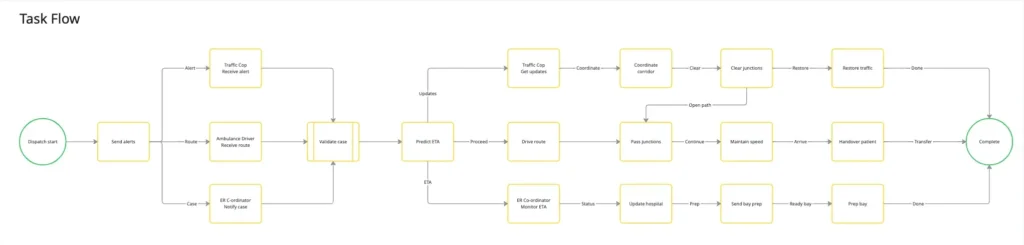
1. Dispatch
The hospital dispatches an ambulance and activates a LifeLane emergency corridor.
Outcome : All participating stakeholders become connected to a shared journey.
2. Transit
The system continuously validates ambulance location and predicts upcoming junction arrivals.
Outcome : Traffic officers receive advance warning before congestion forms.
3. Corridor Creation
Traffic officers receive directional and time-based guidance.
For Example:
‘Ambulance approaching from MG Road. Arrival in 90 seconds.’
Outcome : Traffic clearing becomes proactive instead of reactive.
4. Hospital Preparation
Reliable arrival windows are communicated to emergency departments.
Outcome : Clinical teams can prepare treatment resources before arrival.
5. Arrival at ER
Patient handover occurs with reduced uncertainty.
Outcome : Faster transition from transport to treatment.
Service Blueprint
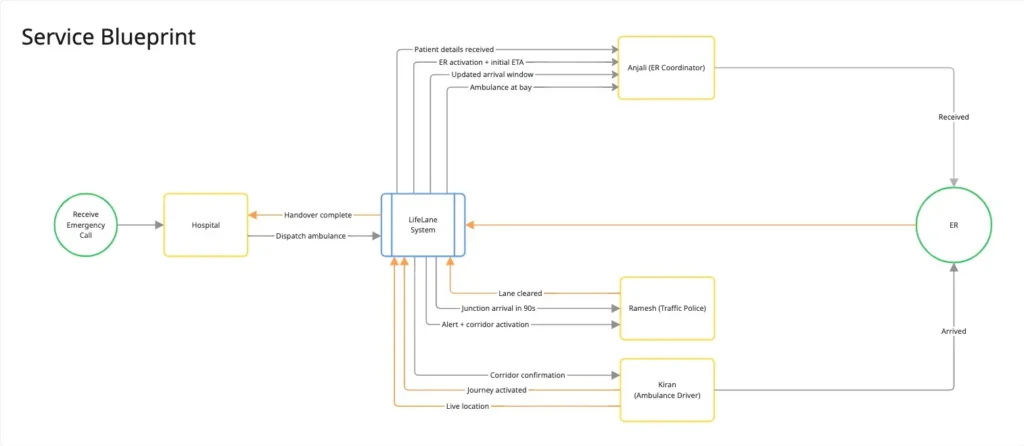
Frontstage
Traffic Officer
- Receives alert
- Creates corridor
Ambulance Driver
- Follows dynamic route guidance
ER Coordinator
- Receives live arrival updates
Backstage
LifeLane Platform
- Processes location events
- Calculates arrival predictions
- Coordinates stakeholder notifications
Traffic Management Systems
- Support corridor planning
Hospital Systems
- Prepare emergency resources
Support Processes
- Emergency dispatch
- Route optimization
- Alert delivery
- Arrival forecasting
- Incident logging
Designing for High-Stress Environments
A. Traffic Officer Experience (Design for Attention Scarcity)
Field observations suggested officers rarely have time to study maps while actively directing traffic.
The interface was designed around:
- Haptic alerts
- Voice guidance
- Landmark-based orientation
- Large glanceable information
Instead of showing complex route maps, the experience communicates:
Passed: Richmond Circle
Approaching: Trinity Junction
ETA: 90 seconds
B. Ambulance Experience (Design for Environmental Constraints)
Drivers require confidence rather than additional information.
The system prioritizes:
- Route reliability
- Corridor readiness
- Dynamic rerouting
⠀The goal was reducing uncertainty during high-pressure decision making.
C. Hospital Experience (Design for Trust)
Emergency departments need operational predictability.
The dashboard focuses on:
- Reliable arrival windows
- Patient transport status
- Resource preparation planning
This allows treatment teams to prepare before the patient enters the facility.
Key Experiences
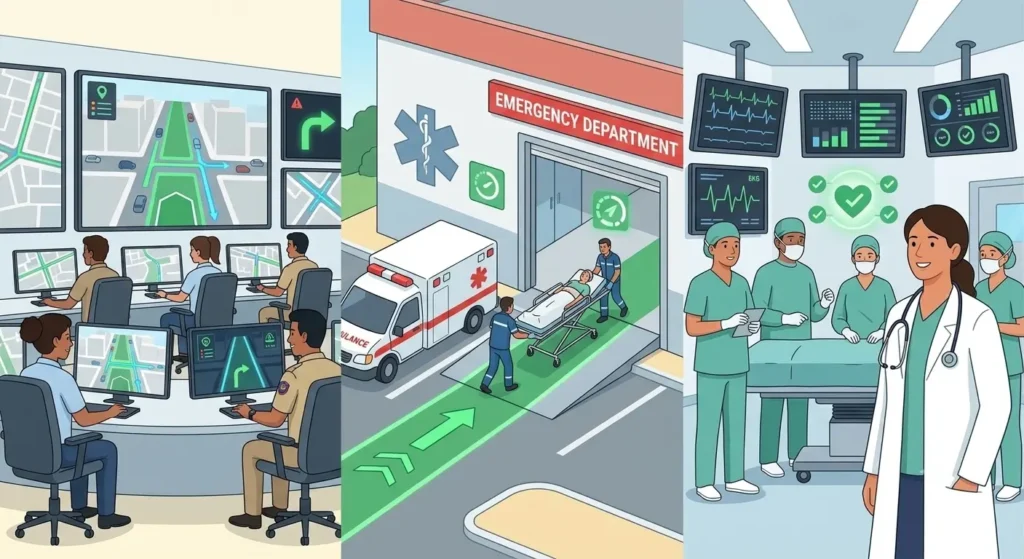
A. Traffic Officer Experience
Rather than showing a map, the interface provides:
- Direction : Ambulance approaching from MG Road
- Context : Passed Corner House Junction
- Time : Arrival in 90 seconds
The interaction can be understood in less than one second.
B. Ambulance Experience
Instead of generic navigation:
- Cleared routes are highlighted
- Congestion events trigger dynamic rerouting
- Future junction readiness is displayed
The goal is confidence, not navigation.
C. Hospital Experience
A command dashboard provides:
- Live ambulance progress
- Patient status integration
- Reliable arrival windows
This allows treatment preparation before arrival.
Outcomes
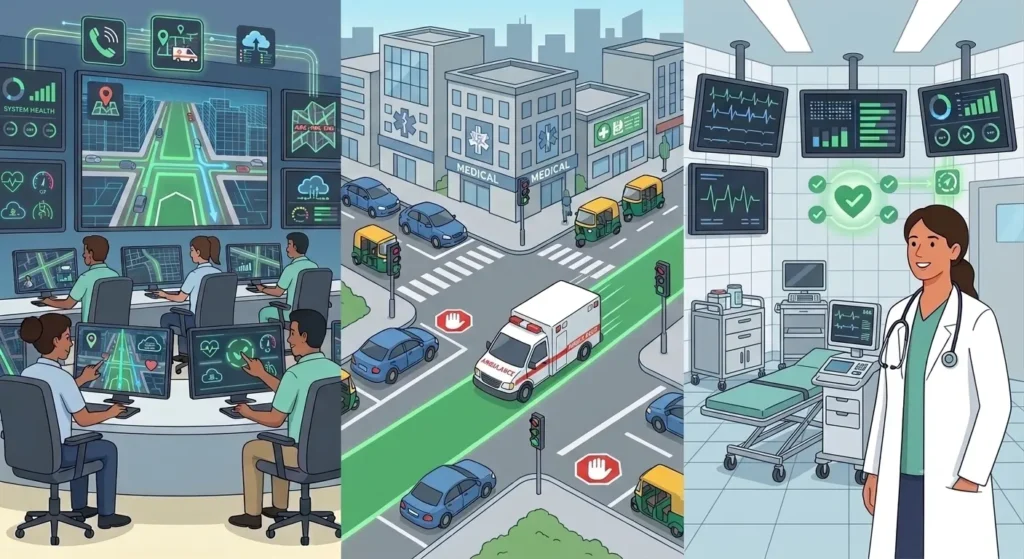
Operational Metrics
- Ambulance transit time reduction
- Junction clearance time reduction
- Arrival prediction accuracy
Experience Metrics
- Traffic officer confidence
- Driver decision confidence
- ER preparedness
Healthcare Metrics
- Reduced treatment delays
- Improved emergency response efficiency
- Better Golden Hour utilization
Reflection
This project challenged me to think beyond interfaces and individual users.
The most important design work was not creating screens, it was redesigning how information moved across a healthcare ecosystem.
By reframing ambulance transport as a service coordination problem rather than a navigation problem, I was able to explore how design can improve continuity of care across multiple organizations and touchpoints.
The project reinforced an important lesson:
Healthcare outcomes are often influenced as much by system coordination as by clinical expertise.