There I was, sitting in a dark theater, heart pounding with anticipation for Mission Impossible: Final Reckoning. Tom Cruise was about to leap off a cliff on a motorcycle. And what did I get before the action began?
Three wedding jewelry ads.
A makeup ad with an actress repeating infallible like a malfunctioning echo.
And a grocery app.
Zero motorcycles. Zero action. Zero connection to why I was there in the first place.
Then came the whiplash of experience #2, a lighthearted family outing to Lilo & Stitch, a fun, gentle kids movie. And what were the ADs again?
More jewelry.
Same actress, same infallible dialogue .
Same grocery app.
My brain didn’t even bother filing the ads. I just ignored & shut down. And the kid? Confused, disengaged, exposed to products that had nothing to do with their world.
What’s Going Wrong? The Case Against Context-Free Advertising
Marketers have become obsessed with celebrity faces, high production, and repetition. But they’re ignoring the most powerful driver of effectiveness in neuromarketing:
Contextual relevance.
When your brain is primed for action, don’t sell it a wedding ring.
When a child is ready for laughter, don’t shout infallible at them in eyeliner.
Advertising doesn’t happen in a vacuum. It happens in a mental, emotional, and cultural setting. If your message clashes with that setting, even the best production money can buy won’t save it.
CASE 1: Action Movie, Romance Ads
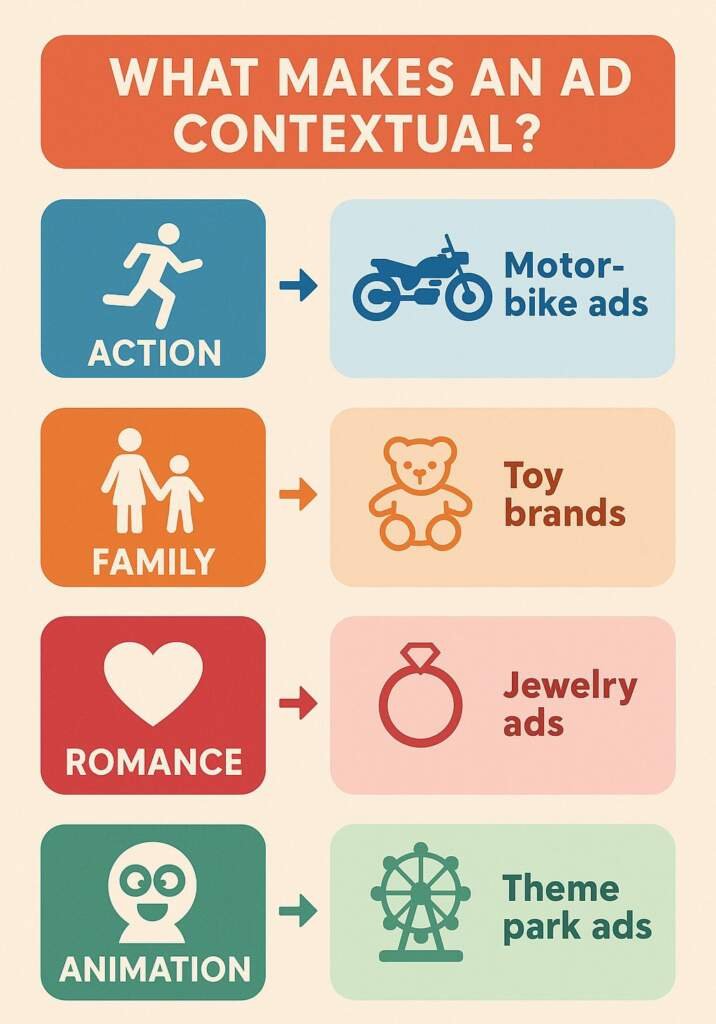
Imagine you’re mentally revving your engine, ready for explosions, stunts, and chase scenes and you’re hit with soft-focus slow-motion weddings. The mismatch is jarring.

What would have worked?
Motorbike brands
Adventure tourism (paragliding, skydiving resorts)
Tactical gear
Airline ads with a thrill-seeker tone
Even energy drinks or wireless earbuds for action lovers
These are congruent with the emotional state and audience mindset. When you align with those, memory encoding spikes.
When you fight it, hello vampire effect, the celeb devours the attention and the brand vanishes.
CASE 2: Kid’s Movie, Grown-Up Glamour
Children’s minds are absorbing stories, characters, values and suddenly they’re being sold cosmetics by an aloof, disconnected adult figure. Worse, parents trying to raise ad-aware, screen-balanced kids now have to shield them from ads in a theater, of all places.
What would have worked?
Toys (even subtle brand stories)
Healthy snacks
Learning apps or family experiences
Movie-themed merchandise
Animated PSAs about kindness, environment, etc.
These could’ve been both entertaining and aligned with the viewing context especially if done with charm, humor, or subtle educational value.
What the Science Says: Attention + Emotion + Memory
In consumer neuroscience, how well an ad works depends on:
Relevance, Does it match my current state?
Arousal, Does it emotionally activate me?
Integration, Does it fit into what I’m experiencing?
The problem with irrelevant ads isn’t just annoyance. It’s cognitive dissonance. Your brain is too smart to invest energy in remembering something that doesn’t fit the scene.
The Fix: Contextual Intelligence
It’s not about banning celebrities. It’s about using them wisely, in the right place, at the right time, saying the right thing.
Smart contextual ad strategy looks like this:
Match genre (don’t pitch lipstick in a war movie) Match mood (don’t drop sadness before a comedy) Match audience lifecycle (don’t sell jewelry to 7-year-olds) Match timing (1 ad for impact > 3 repeated until we break)
Final Thought
Theaters offer a rare chance: a captive, emotionally invested audience. And we’re wasting it on noise.
It’s time brands remembered this: You’re not just placing an ad. You’re joining a moment. If you don’t respect that moment, you’ll be forgotten before the first line of dialogue even starts.
Let’s stop throwing glitter at the wall and hoping it sticks. Let’s craft smarter, sharper, context-aware advertising.
And please, if I came for Tom Cruise or Stitch, don’t give me infallible lip gloss.
Follow for more on neuromarketing, ad psychology, and brand storytelling that actually works.