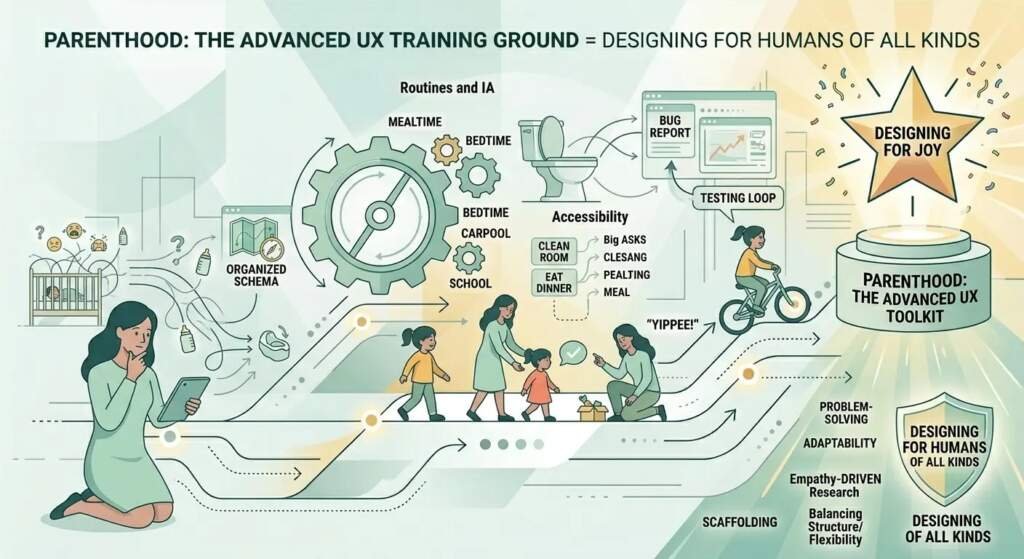
When I stepped away from my career in user experience (UX) design to raise my children, I thought I was leaving behind wireframes, usability testing, and user flows. But as it turns out, parenting is one of the most immersive, real-world UX projects I’ve ever worked on. My ‘users’ are curious, unpredictable, and constantly evolving and just like in design, my role is to create environments, interactions, and systems that are intuitive, supportive, and growth-oriented.
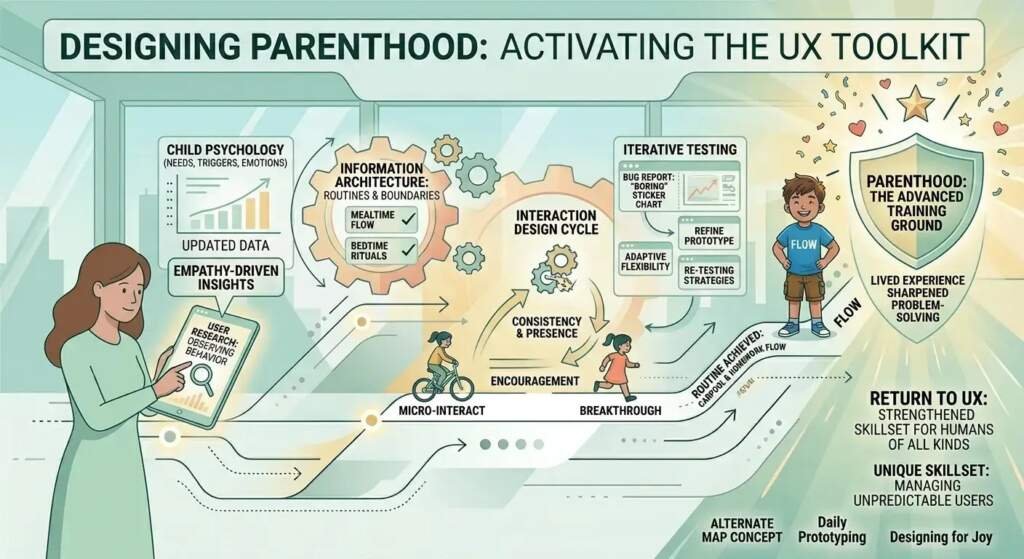
Here are a few ways I’ve found UX principles overlapping with child-rearing:
User Research = Knowing Your Child (Until the Scope Changes)
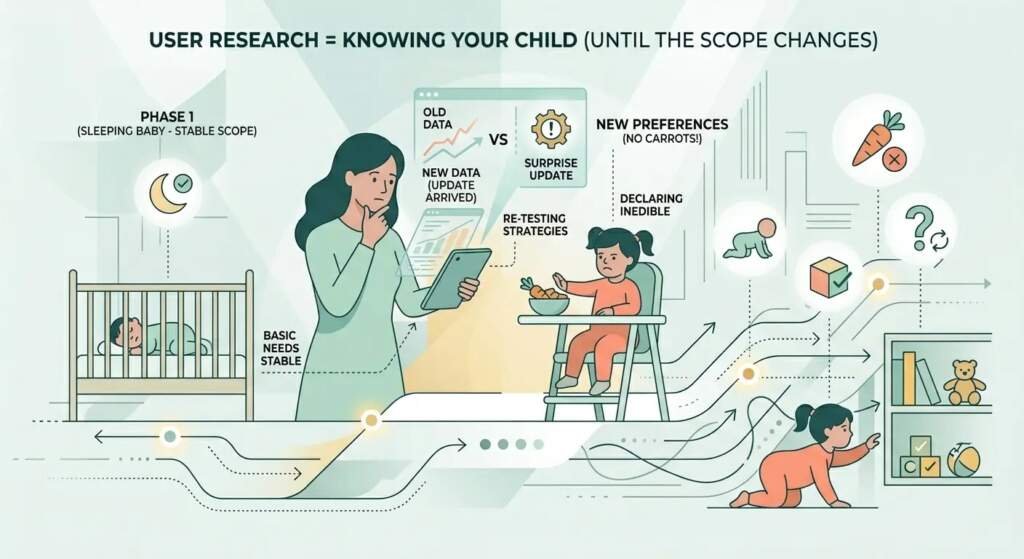
In UX, research helps us understand user needs and behaviors but users change over time, and so do children. The first few years of parenting feel like working on a project with constantly shifting requirements.
As a parent, I spend a lot of time doing exactly that: observing my child’s behavior, noticing their triggers, their joys, and their frustrations.
Just like no two users are the same, no two children are alike. What soothes one child might overstimulate another. Good parenting (like good design) starts with empathy-driven research.
Every three months (sometimes every three weeks!), the ‘scope’ seems to reset. The baby who finally sleeps through the night suddenly learns to crawl and is into everything. The toddler who loved carrots last week now declares them inedible. Just when you think you’ve mapped their patterns and behaviors, a surprise update arrives : new skills, new emotions, new challenges.
Like any good UX researcher, parents have to stay adaptable: observe, re-interpret, and re-test strategies. The key is embracing the unpredictability rather than expecting a static user profile. Parenting, like design, is an ongoing discovery process.
Information Architecture = Routines and Boundaries
(From Chaos to Cogwheel)
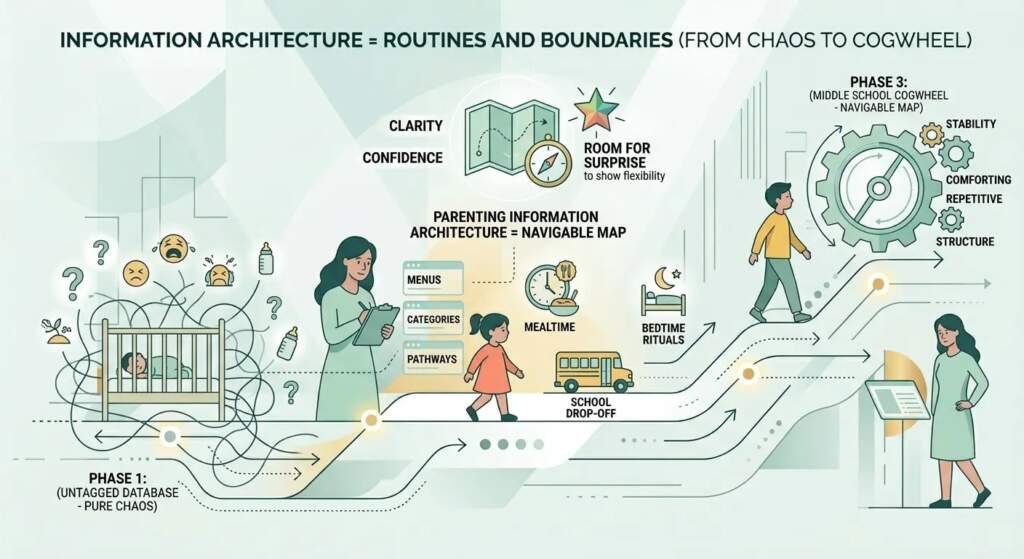
In UX, information architecture brings order to complexity of menus, categories, and pathways that guide users where they need to go. Parenting, on the other hand, starts out feeling like pure chaos.
The first three years are like an untagged database of cries, naps, feedings, meltdowns ; everything feels unpredictable and unstructured. But as children grow into preschoolers, routines slowly start to emerge: mealtimes, school drop-offs, bedtime rituals. Boundaries take shape, and life begins to feel less like scrambling and more like a flow.
By the time kids hit middle school, those routines can run like a well-oiled cogwheel. Sometimes comforting, sometimes repetitive, almost like a hamster wheel. Structure gives stability, but it also reminds us to inject flexibility and joy into the system so it doesn’t become purely mechanical.
Just like in UX, information architecture in parenting isn’t about rigid rules. It’s about creating a navigable map that helps children (and parents) find their way through daily life with clarity, confidence, and maybe a little room for surprise.
Interaction Design = Communication
(Building Trust Through Consistency and Presence)
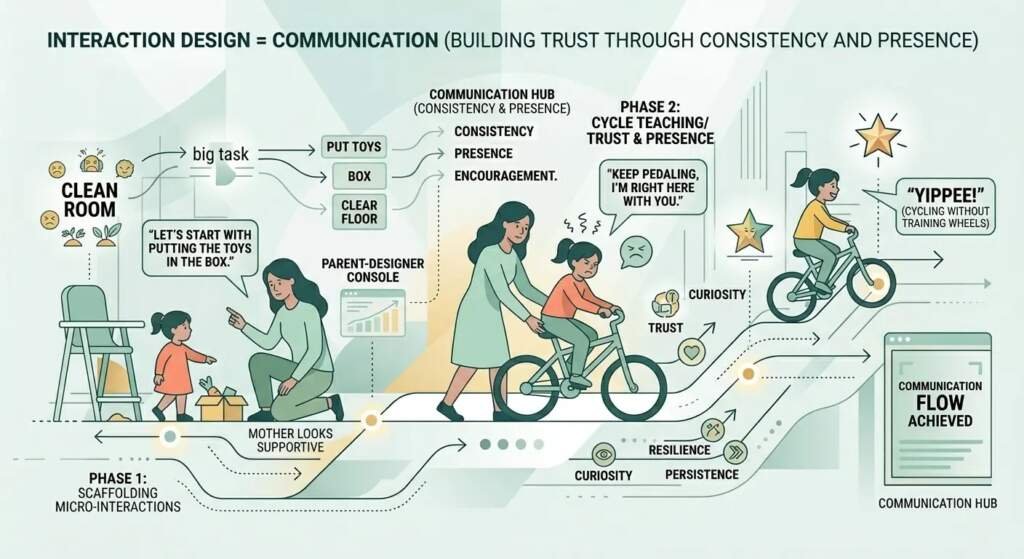
In UX, interaction design is about how users engage with a product. The buttons they press, the feedback they receive, the flow they follow. For children, those ‘interactions’ come through communication.
Predictable interactions build trust. When a child knows that a certain action brings a consistent response, they feel secure. This applies to discipline, affection, and encouragement alike. But communication with children is more than just predictability. It’s about quality one-on-one time and the way we break down instructions into smaller, achievable steps.
Instead of saying, ‘Go clean your room’, the parent-designer guides the child through micro-interactions: ‘Let’s start with putting the toys in the box.’ This scaffolding helps them stay engaged and builds confidence. Encouraging curiosity (‘Why do you think the blocks fit here?’), resilience (‘Let’s try again, I know you can do it’) and persistence (‘Keep pedaling, I’m right here with you’) turns everyday moments into powerful interaction designs.
Nothing illustrates this better than teaching a child to cycle. At first, there are the ‘sad grunts’ of frustration, the wobbles, the tears. But when you show up consistently for them with a steady hand on the seat, calm encouragement, clear step-by-step guidance that moment of breakthrough arrives: the ‘yippee!’ of cycling on their own without training wheels. It’s a small milestone for the child, but an enormous win for the parent-designer too.
Accessibility = Meeting Them Where They Are
Asking a two-year-old to ‘clean their room’ is like asking a new user to navigate a complex dashboard without onboarding, overwhelming, confusing, and almost guaranteed to fail. Breaking tasks into small, clear steps (‘let’s put the blocks in the box first’j makes the experience accessible and achievable.
Another example is mealtime. Telling a preschooler, ‘Eat your dinner’ is a broad instruction that often leads to resistance. It’s the equivalent of dropping a user into a feature-heavy app without a walkthrough. Instead, breaking it down into approachable steps ‘Let’s take two bites of broccoli first, then we can move on to the rice’ creates a manageable sequence. Each small success builds momentum, helping the child feel capable rather than defeated.
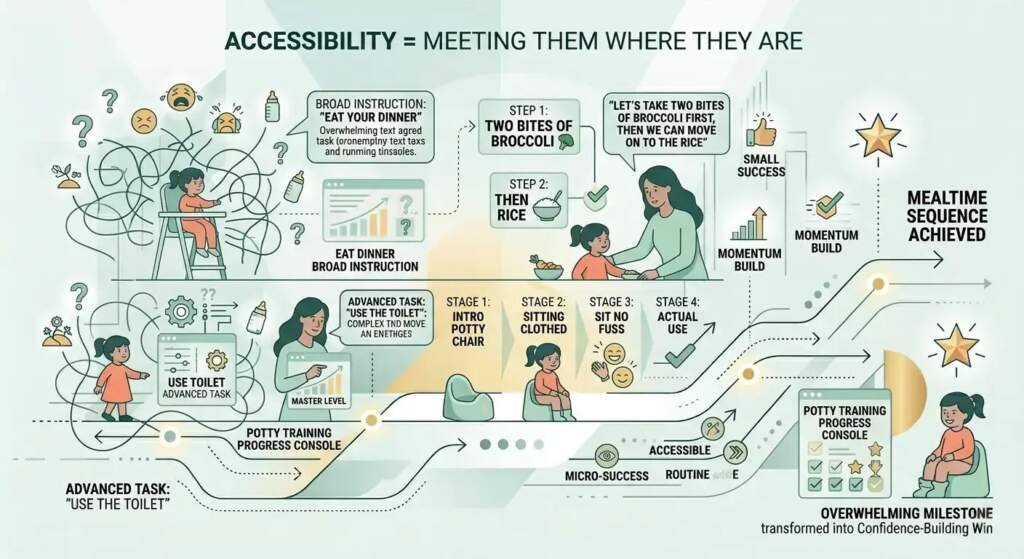
And then there’s potty training, a true milestone for today’s kids, but also one of the most overwhelming experiences for both child and parent. Asking a toddler to suddenly ‘use the toilet’ is like asking a new user to master advanced settings on day one. Instead, progress happens in stages: introducing the potty chair, sitting fully clothed first, celebrating when they sit without fuss, then moving step by step toward actual use. Each stage is its own micro-success, turning what feels impossible into something accessible, achievable, and eventually routine.
Just like inclusive UX design meets users where they are, accessible parenting is about designing interactions that children can realistically succeed in, transforming overwhelming milestones into confidence-building wins.
Iterative Design = Trial and Error (Because Kids Keep Changing the Rules)
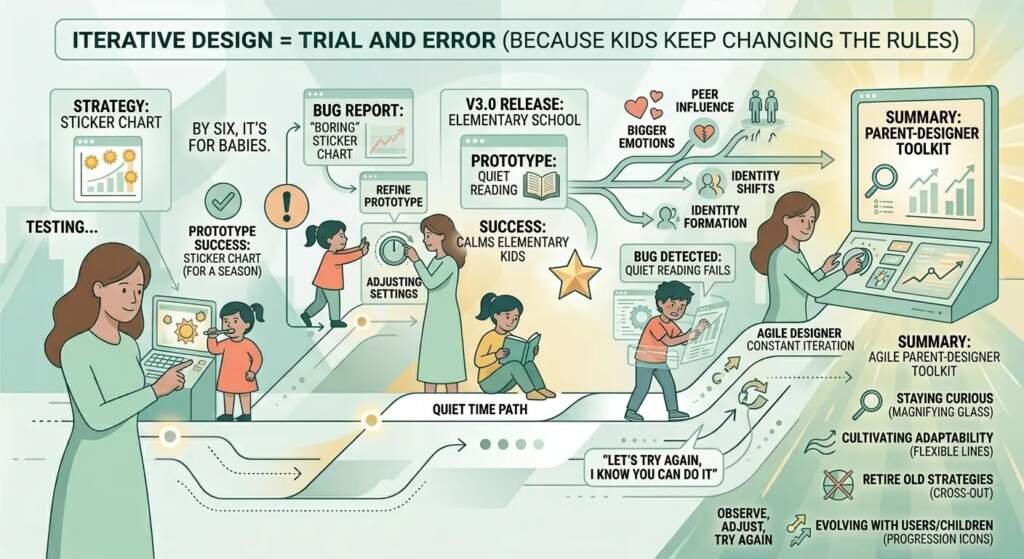
In UX, we never get it perfect the first time. We prototype, test, and refine. Parenting is no different. Some strategies fail spectacularly; others succeed but only for a season. The important part is to observe, adjust, and try again knowing that children, like users, grow and change.
What worked beautifully with a toddler often doesn’t translate to a preschooler. A sticker chart might motivate a three-year-old to brush their teeth, but by six, it’s ‘boring’ or ‘for babies.’ Likewise, a strategy that calms an elementary school kid like five minutes of quiet time with a favorite book won’t necessarily work for a middle schooler wrestling with bigger emotions, peer influence, and identity shifts.
It’s like running repeated usability tests on different versions of the same product. Each stage of childhood is a new release familiar in some ways, but with new features, new bugs, and new needs. As parents, we become agile designers, carrying forward lessons learned but constantly iterating to meet the evolving ‘user experience’ of our children.
The real skill isn’t in finding a once-and-for-all solution, but in cultivating adaptability staying curious, willing to experiment, and ready to retire strategies that no longer serve. Just as good design evolves with its users, good parenting evolves with its children.
Delight = Joyful Moments (Finding Magic in the Mundane)
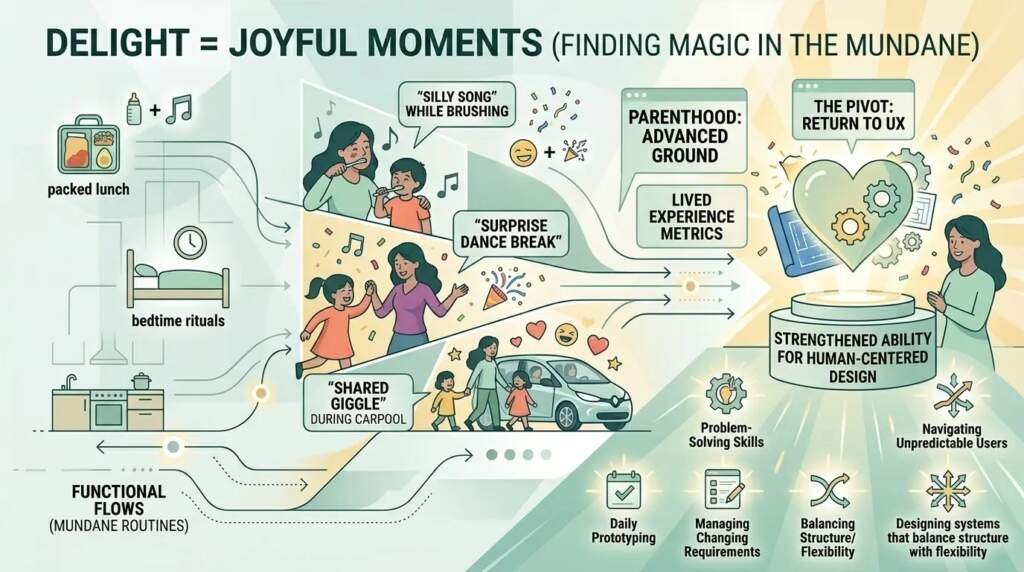
In UX, the best designs aren’t just functional they delight. They surprise users with ease, charm, or joy in ways that turn a necessary task into a memorable experience. Parenting works the same way.
Much of daily life with kids is filled with mundane ‘flows’: packing lunches, herding them through bedtime routines, rushing through morning chaos. But when we sprinkle in moments of delight a silly song while brushing teeth, a surprise dance break in the kitchen, or a shared giggle during carpool, the whole experience transforms. What could have been just another transaction becomes a memory.
As children grow and routines stabilize, family life can start to resemble a well-oiled cog machine. Everything runs smoother, almost like the hamster wheel we designed earlier: efficient, predictable, and structured. That structure creates space for joy to shine even brighter, because we’re no longer stuck in pure survival mode.
And here’s the beautiful part: parenting has been its own advanced training ground in UX. It has sharpened universal problem-solving skills, navigating unpredictable users, prototyping new approaches daily, managing changing requirements, and designing systems that balance structure with flexibility.
So when I think about stepping back into the industry, I realize I’m not just returning with my old UX toolkit. I’m bringing with me years of lived experience designing for the most challenging, rewarding users imaginable: children. And that’s not a detour, it’s a unique skill set that strengthens my ability to design for humans of all kinds.
Because at its core, whether it’s brushing teeth or onboarding to a new product, delight is about creating experiences that not only work but bring joy. Parenting has taught me to look for those moments relentlessly and that’s a mindset I’ll carry back into UX with renewed energy.