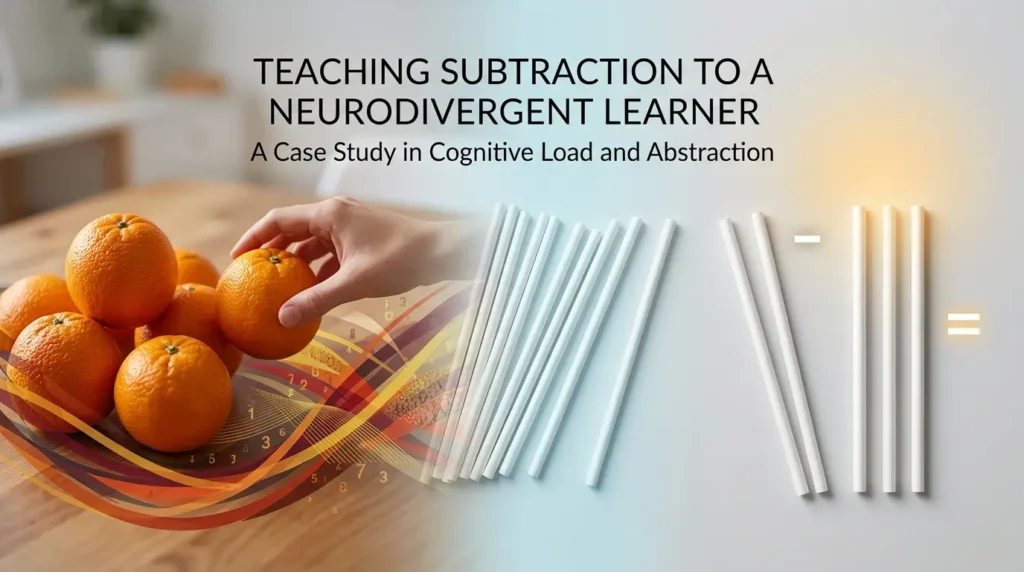
A Case Study in Cognitive Load and Abstraction
A Note from the Parent
I am not a trained educator. I am a parent who found myself, like many parents of neurodivergent children, improvising at the kitchen table trying to bridge the gap between how my child experiences the world and how most instruction is designed to be delivered.
This case study is drawn from a single session that has stayed with me. Not because it was dramatic, but because of what it revealed: the exact thing I thought was helping, making math tangible and grounding it in real objects was precisely what was getting in the way.
The solution, when I finally stumbled onto it, was almost absurdly simple. But the moment my child’s face changed, I understood something entirely new about how they learn, and about the assumptions quietly embedded in even the most basic teaching methods.
I’m writing this down because I hope it might be useful to someone else sitting at a similar table, trying to figure out why a perfectly reasonable explanation keeps failing to land.
Background
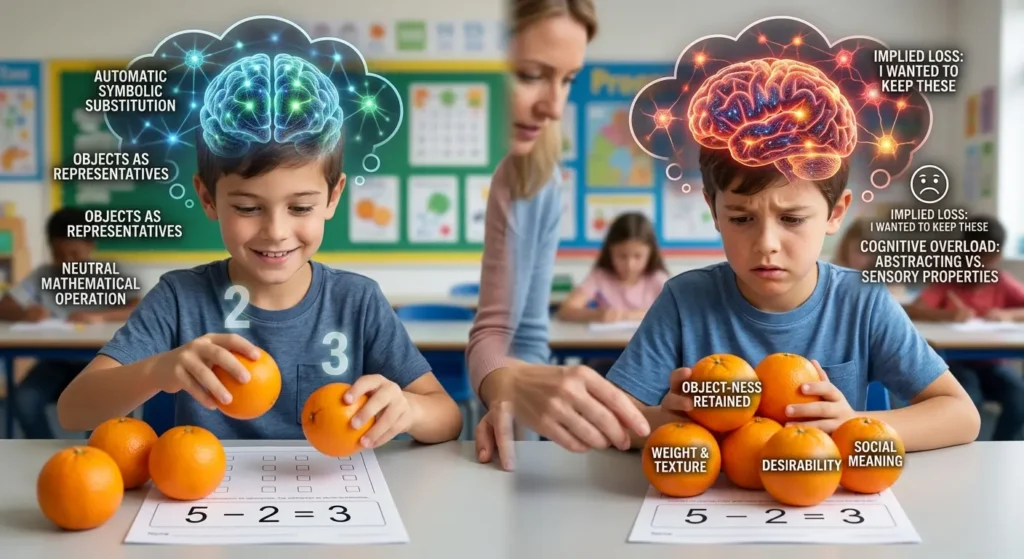
This case study looks at a specific hurdle we hit in home learning: teaching the concept of mathematical subtraction to a neurodivergent child. My child demonstrated strong verbal ability and number recognition, but struggled deeply to engage with subtraction as a formal operation. What started as a pedagogical headache turned into a window into how concreteness typically considered the gold standard in early math instruction can actually become a barrier for learners who process the world with heightened literalness.
The Presenting Challenge
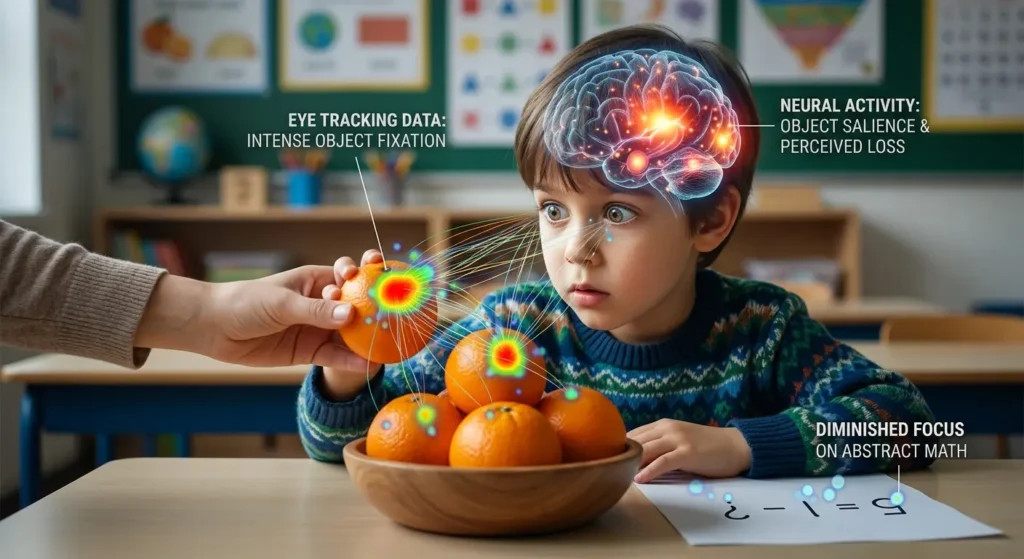
Standard early math instruction relies heavily on physical objects. You put down five oranges, take two away, and ask what’s left. The logic feels intuitive: make the abstract concrete. Make the invisible visible.
For my child, however, that concreteness wasn’t clarifying. It was destabilizing.
When I brought out the objects, my child’s attention locked immediately onto the items themselves rather than the mathematical operation. The second an item was designated for removal, frustration set in. They weren’t confused; they were emotionally activated. The oranges being taken away were not a neutral illustration they were actual oranges being taken away. The mathematical point of the exercise was entirely swallowed by the social and emotional reality of loss embedded in the scenario.
This pattern repeated no matter what objects we used. The props changed, but the dynamic did not. My child wasn’t failing to understand subtraction; they were understanding the situation too literally for the abstraction to take hold.
The Cognitive Insight
This exposed a massive mismatch between standard instructional assumptions and my child’s actual processing style. Concrete object pedagogy assumes a learner will treat the items as representatives of a quantity, symbols in three-dimensional form. For many learners, this symbolic substitution is automatic and unconscious.
For neurodivergent learners, particularly those with heightened literal processing, objects do not shed their “object-ness” so easily. An orange remains an orange. It has weight, desirability, and social meaning, even when placed inside a math problem. I was asking my child to perform a complex cognitive operation (abstracting away the object’s physical traits to focus only on its numerical value) that completely clashed with how their attention was naturally organized.
Reframed, the instructional problem was this: subtraction, as typically taught, assumes a symbolic distance from the concrete. My child needed a medium that was neutral by design one that carried zero emotional valence, no object permanence pull, and no implied narrative of loss.
The Intervention
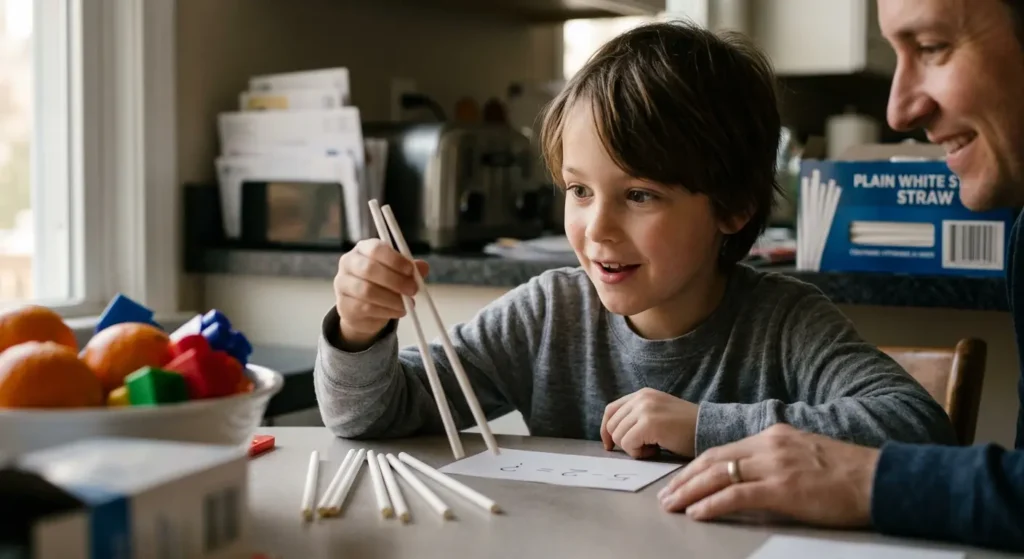
After hitting a wall with physical objects, I changed tactics. Rather than simplifying the math or trying yet another type of toy, I changed the medium entirely: plain, single-colored white paper straws.
This wasn’t a carefully plotted curriculum choice; it was a parent reaching for whatever was on the counter. But looking back, the fit was incredibly precise.
The properties that made the white paper straws effective were:
- Neutrality: Straws carry no inherent desirability. They aren’t food or toys. Taking one away triggered zero emotional response.
- Uniformity: Every straw was identical. There was no ‘favorite’ straw to lose, and no variation to attach meaning to. They functioned as pure units.
- Abstraction by design: A white paper straw is barely a physical object. It lacks color variation, texture, or story. It exists at exactly the right distance from the real world to be handled without being wanted.
- Manipulability: We could still group, move and count them, preserving the kinesthetic component of the lesson without the emotional baggage.
No beloved object was taken away. Nothing desirable disappeared. The mathematical structure of subtraction remained fully intact, but we had stripped away the contextual interference that was blocking comprehension.
The Result
The shift was immediate.
My child, who had been frustrated and disengaged just moments before, grinned. It was that unmistakable look of a cognitive click,the expression that signals not just getting the right answer, but understanding the structure behind it. The concept had landed.
What followed proved it wasn’t a lucky guess. They began applying the operation independently, working through additional problems without any prompting. The barrier had never been their ability. It was the medium.
Implications
This experience illustrates something that formal math pedagogy often misses: concreteness is not universally scaffolding. For learners who process literally, real-world objects can introduce exactly the kind of cognitive and emotional noise that abstract instruction is supposed to eliminate.
The intervention here didn’t simplify the concept; it clarified the signal by dropping the noise. My child didn’t need fewer oranges. They needed the oranges removed from the equation entirely.
For educators and parents navigating neurodivergent learning, this offers a counterintuitive heuristic worth testing: when a concrete example is failing, the problem may not be the complexity of the concept. It might be the concreteness of the example. The right manipulative isn’t always the most relatable one. Sometimes, it is the most inert one, just present enough to count, but invisible enough not to matter.