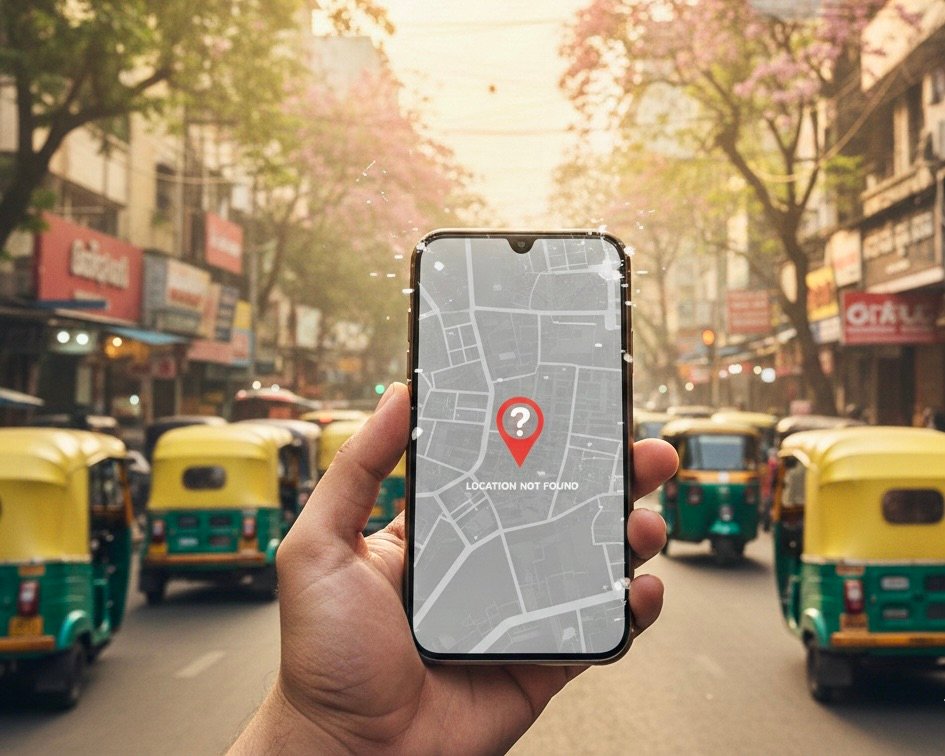
I’m almost a Level 9 Local Guide on Google Maps. Let that sink in for a moment. I’ve spent hours contributing reviews, updating locations, correcting business information, and helping fellow users navigate my city. I’ve done this voluntarily, believing in the promise that crowdsourced mapping could make our digital lives better. But here’s the uncomfortable truth: I feel completely useless.
We have multiple massive Google offices right here in Bangalore, India. This is one of the world’s most dynamic tech hubs, an emerging economy with an even more emerging market. Yet somehow, Google Maps treats us like we’re an afterthought a feature request that got buried in someone’s backlog and forgotten. The map feels built for Mountain View, optimized for Manhattan, perfect for Melbourne. But for Bengaluru? We’re just making do with table scraps.
Let me walk you through why I’m this frustrated.
1. The Alt Profile Feature: Welcome to 2004, Google
When Google Reviews finally rolled out the alternate profile feature in 2024, my first thought was: ‘Well, well, well… you’re only 20 years late.’
For years, I’ve wanted to leave honest reviews about restaurants with terrible food or sketchy service practices. You know, actually help fellow foodies avoid a bad experience. But here’s what happens when you do that: you get threatening replies. I’ve received them. Angry restaurant owners or their hired goons sliding into my review comments with thinly veiled intimidation because my real profile with my name and photo is right there for everyone to see.
So what’s the rational response? Stop leaving honest reviews. Protect yourself. Stay silent.
Google finally gave us the ability to review anonymously with alternate profiles, but guess what? Nobody cares anymore. The trust in Google Reviews has eroded so badly that people don’t even read them. The feature arrived at precisely the moment it became irrelevant. Congratulations, Google. Impeccable timing.
2. Food Trucks Don’t Exist in Google’s Universe
Does Google not have food trucks in America? I’m genuinely asking. Because apparently, the concept of a mobile food business doesn’t compute in the Google Maps taxonomy.
Bengaluru has a thriving food truck scene. These aren’t fly-by-night operations; they’re legitimate businesses with loyal followings. But here’s the problem: when a food truck moves to a new location (which is, you know, the entire point of a food truck), Google Maps marks it as ‘Temporarily Closed.’
And when the food truck owner wants to update their location, do they come to Google Maps? Of course not. They update it on Instagram, where their actual customers are. So guess who has to fix it? Us. The Local Guides. The volunteers.
I try to update the location. I carefully pin the new spot. I submit the edit. And what does Google Maps’ AI tell me? ‘Not Accepted.’
Not accepted. No explanation. No criteria. Just rejected.
You want to know what could have solved this years ago? If Google Maps had teamed up with Foursquare when Foursquare was actually relevant. Together, they could have built something that understood how real-world businesses actually operate. Instead, we’re stuck with a system that thinks every business is a brick-and-mortar establishment with a fixed address and a 9-to-5 schedule.
3. Fake Reviews: The Emperor Has No Clothes
Let’s talk about fake Google reviews. The avalanche of glowing 5-star testimonials that make a restaurant look like it’s serving food blessed by the gods themselves. You read through dozens of suspiciously similar reviews, your mouth watering, your expectations sky-high.
Then you show up. You order. You eat.
And the food tastes like dogshit. Absolute dogshit. And it costs as much as a SpaceX rocket component.
The trust in Google Reviews has been broken for years now. Everyone knows it. The platform is gamed by businesses buying reviews, by competitors leaving fake negative reviews, by automated bots that wouldn’t know a good biryani from a bowl of sawdust. And what has Google done about it? Not nearly enough. The verification systems are weak, the detection is spotty, and the consequences for getting caught are minimal.
So we’re left in this bizarre purgatory where the reviews exist, but nobody really believes them. We still check them out of habit, like reading horoscopes we don’t actually take seriously.
4. Ghost Businesses Haunting Our Maps
Here’s something that should be impossible in 2026: non-existent shops, restaurants, and businesses cluttering up Google Maps in a city where literally everyone from slum dwellers to tech CEOs to venture capitalists carries an Android phone.
Think about that. The penetration is nearly universal across all socio-economic levels. Google has more data points walking around Bengaluru than almost anywhere else in the world. And yet, the map is riddled with outdated information, permanently closed businesses still listed as open, and phantom locations that never existed in the first place.
The problem isn’t a lack of potential contributors. The problem is that Google’s gamification is pathetically weak. Nobody cares about being a Local Guide. The levels mean nothing. The badges are worthless. There’s no real incentive, no meaningful reward, no social capital to be gained from contributing.
Google needs to completely rethink how they motivate people to keep the map accurate. Make it actually fun. Make it meaningful. Make people care about reaching Level 10 the way they care about Reddit karma or Instagram followers. Right now, the Local Guides program feels like a participation trophy system that nobody asked for.
5. The Ultimate Irony: You Can’t Actually Explore with Google Maps
Should you use Google Maps to explore a new area of Bangalore? Definitely not.
It’s absurd. It’s dreadful. It’s the ultimate failure of a mapping application: we still have to stop and ask strangers for directions in our own city. A city with multiple Google offices. A city full of Google employees who presumably use Google Maps themselves and witness these failures firsthand.
How is it possible that in 2026, with all the technology at Google’s disposal Street View cars, satellite imagery, AI, machine learning, millions of Android phones transmitting location data that the basic information is still so unreliable?
Should updating be done via users? Sure, but make it worth their while. Should Google send Street View vehicles around more often? Absolutely, especially in rapidly changing neighborhoods. Should there be better verification systems? Obviously.
The whole approach needs an overhaul. Google Maps needs to stop treating mapping like a solved problem and start treating it like the dynamic, constantly evolving challenge it actually is especially in markets like ours.
A Final Word: We Exist Too
I’m writing this not as a hater, but as someone who genuinely wants Google Maps to be better. I’ve invested hundreds of hours into making it better for my community. I’m almost Level 9 because I believed in the vision.
But belief isn’t enough when the reality keeps disappointing.
Bengaluru isn’t a second-tier market anymore. India isn’t a nice-to-have. We’re not just users; we’re contributors, evangelists, and unpaid quality assurance testers for your product. We deserve a Google Maps that actually works for how we live, how our businesses operate, and how our cities function.
The technology exists. The data exists. The people willing to help exist. What’s missing is the will to make mapping in emerging markets as good as it is in Mountain View.
Until that changes, I’ll keep contributing. I’ll keep updating. I’ll keep hoping. But I’ll also keep feeling a little bit useless, wondering why a company with infinite resources can’t seem to get the basics right in one of the world’s most important tech cities.
Google, we’re right here in Bangalore. Multiple offices’ worth of you. Can you finally see us on your map?