A Scaffolded Media Introduction for a Generation Alpha Neurodivergent Child
Abridged Version
Copyrighted material. Not for redistribution. Please reach out directly for permissions or citation details.
Overview
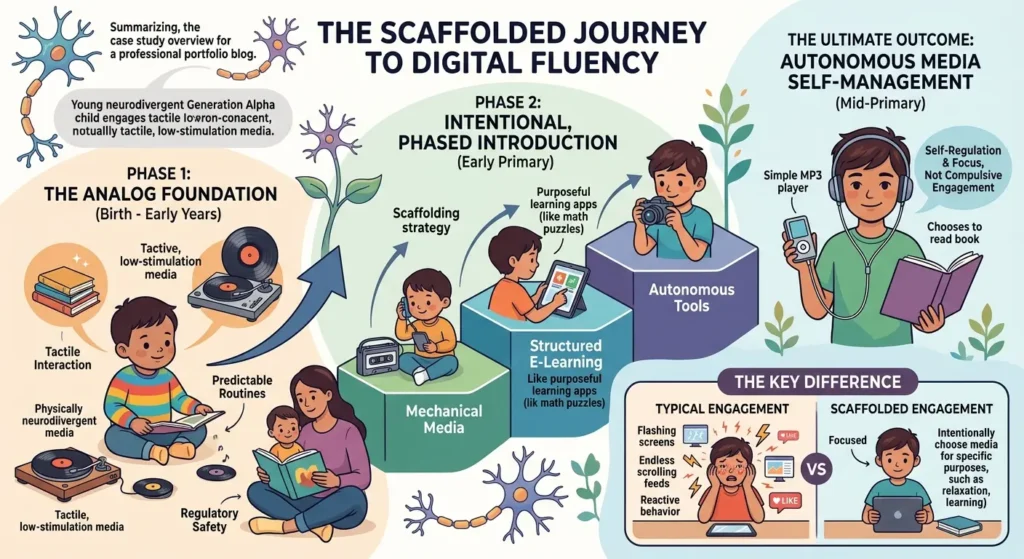
This case study explores the intentional, phased introduction of media to a neurodivergent Generation Alpha child from birth through early primary school.
Rather than adopting an ideology of techno-refusal, this approach utilized a developmentally sequenced scaffolding strategy.
The ultimate outcome was a child capable of autonomous media self-management without falling into compulsive, dopamine-driven engagement patterns.
The Challenge: Dopamine vs. Development
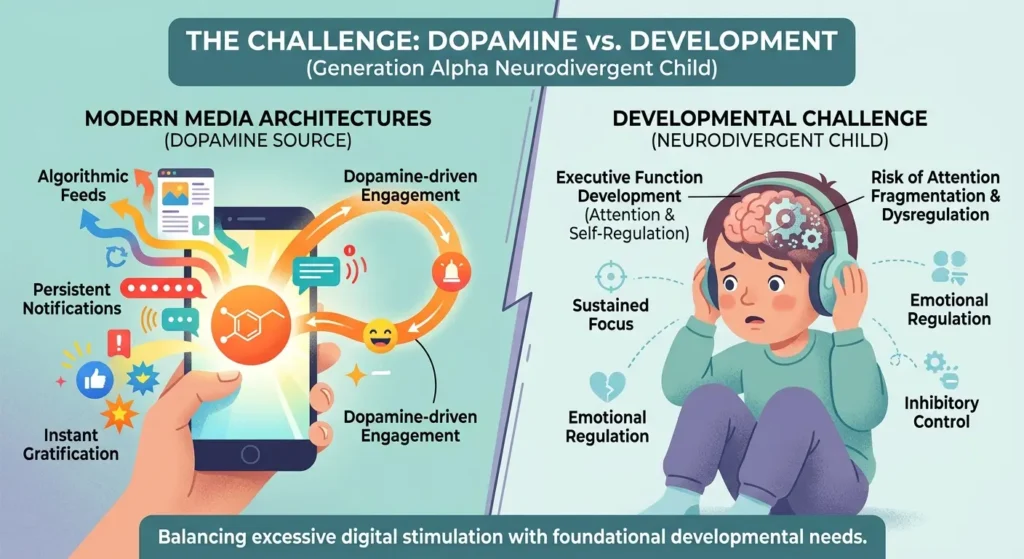
Generation Alpha is the first cohort to grow up entirely within the smartphone era. Modern media architectures characterized by algorithmic feeds, persistent notifications, and instant gratification actively compete with the development of executive function. For a neurodivergent child with a sensitized nervous system, this presents a profound developmental challenge, risking dysregulation and attention fragmentation.
The Behavioral & Cognitive Framework
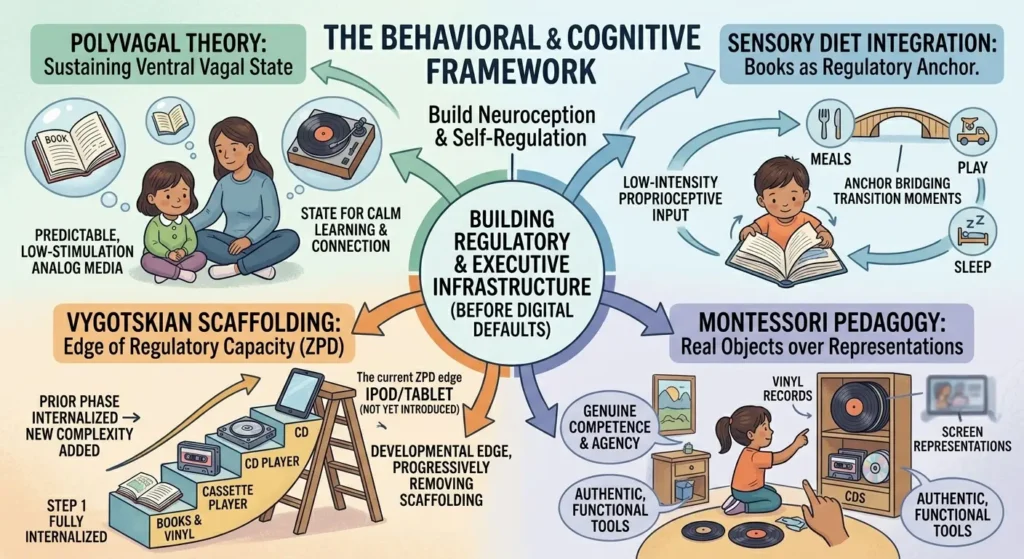
To build the child’s regulatory and executive infrastructure before introducing digital defaults, the home environment was carefully curated using several foundational models:
- Polyvagal Theory: Predictable, low-stimulation analog media (like books and vinyl) was used to sustain the ventral vagal state the neurological condition necessary for calm learning and connection.
- Sensory Diet Integration: Books functioned as a literal sensory regulation tool. The physical handling of pages provided low-intensity proprioceptive input, acting as a sensory anchor to bridge highly dysregulating transition moments between meals, play, and sleep.
- Vygotskian Scaffolding (ZPD): Media complexity was introduced strictly at the edge of the child’s current cognitive and regulatory capacity. New devices were only introduced once the prior analog phase was fully internalized.
- Montessori Pedagogy: The environment prioritized real objects (actual vinyl, cassettes, and CDs) over screen-based representations, conferring genuine competence and agency.
The Phased Media Journey
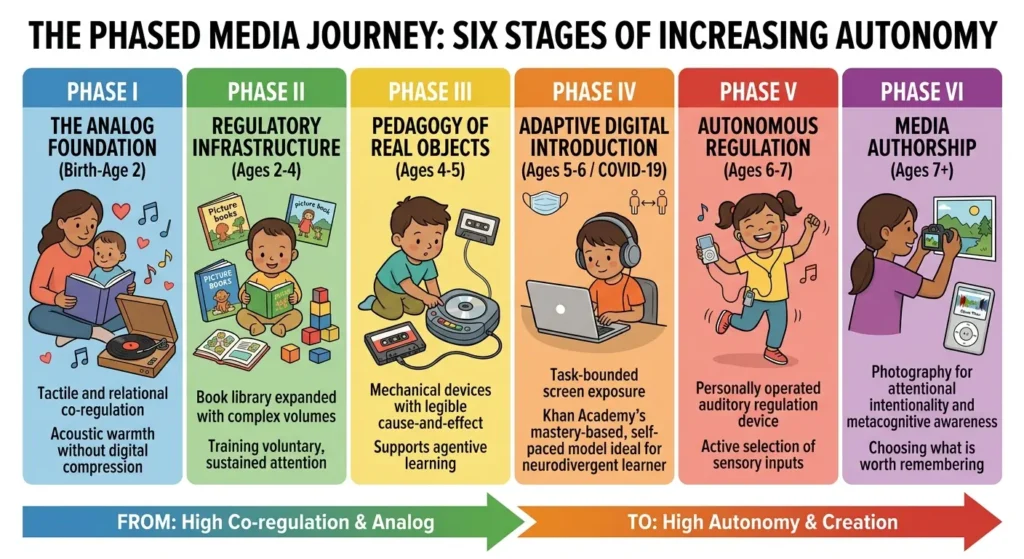
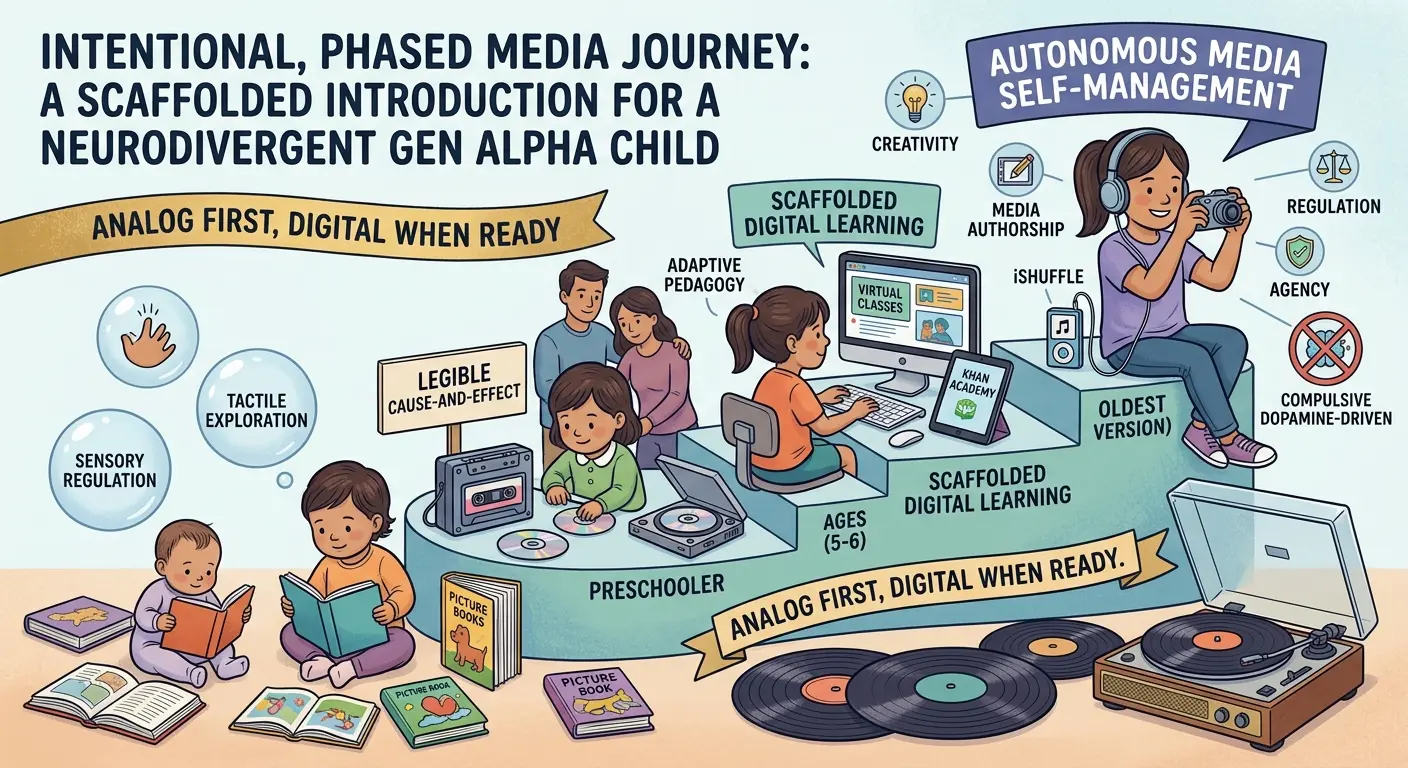
The scaffolding progressed through six distinct phases of increasing autonomy:
- Phase I
The Analog Foundation (Birth–Age 2):
Focused on tactile and relational co-regulation through books and vinyl records, which provided acoustic warmth without digital compression artifacts. - Phase II
Regulatory Infrastructure (Ages 2–4):
The book library expanded to include thicker, visually complex volumes to train voluntary, sustained attention and executive function. - Phase III
Pedagogy of Real Objects (Ages 4–5):
Cassette and CD players were introduced. These mechanical devices offered legible cause-and-effect physicality that touchscreens conceal, supporting agentive learning. - Phase IV
Adaptive Digital Introduction (Ages 5–6 / COVID-19):
Screen exposure was introduced out of necessity, but kept task-bounded and purposeful. The child utilized Khan Academy, whose mastery-based, self-paced model proved to be an ideal fit for a neurodivergent learner requiring individualized pacing. - Phase V
Autonomous Regulation (Ages 6–7):
An iPod Shuffle with headphones provided the child with her first personally operated auditory regulation device. Free from screens and algorithmic engines, it allowed her to actively select sensory inputs to manage her own regulatory state. - Phase VI
Media Authorship (Ages 7+):
The child progressed to an iPod using spatial Cover Flow navigation and a personal digital camera. Photography became a tool for attentional intentionality and metacognitive awareness choosing what is worth remembering.
Outcomes & Key Takeaways
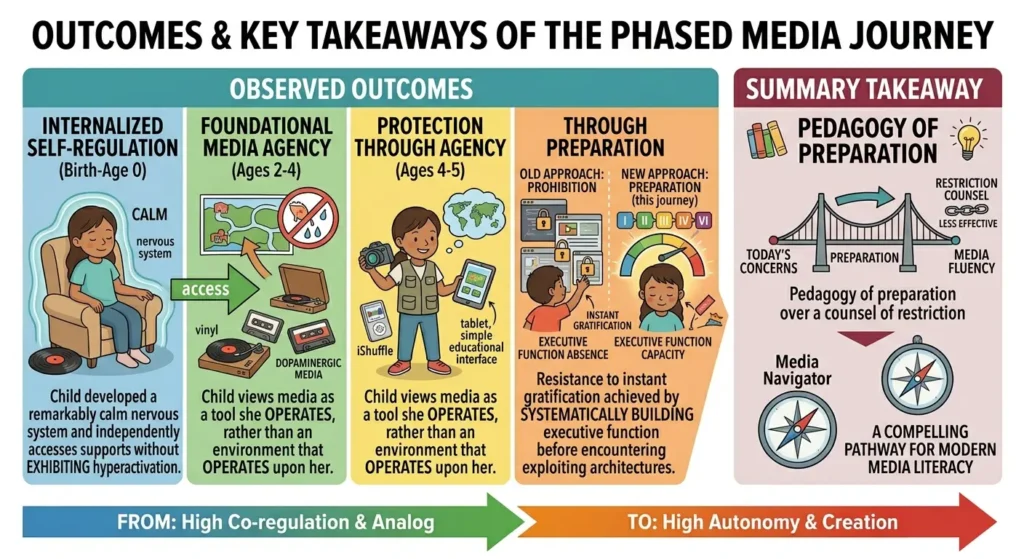
By treating media introduction as a sequentially designed experience, the following outcomes were observed:
- Internalized Self-Regulation
The child developed a remarkably calm nervous system and can independently access regulatory supports (like music or books) without exhibiting the hyper-activation tied to dopaminergic media. - Foundational Media Agency
The child views media as a tool she operates, rather than an environment that operates upon her. - Protection Through Preparation
Resistance to instant gratification was achieved not through strict prohibition, but by systematically building the child’s executive function capacity before she encountered architectures designed to exploit its absence.
In an era of escalating screen time concerns, this approach offers a compelling pedagogy of preparation over a counsel of restriction.